How much tree removal costs and what drives the price
Tree removal is one of those jobs where the price can swing a lot from one yard to the next. The safest way to shop it is to understand the cost drivers, get the scope in writing, and compare estimates from licensed, insured tree companies.
Typical tree removal price range
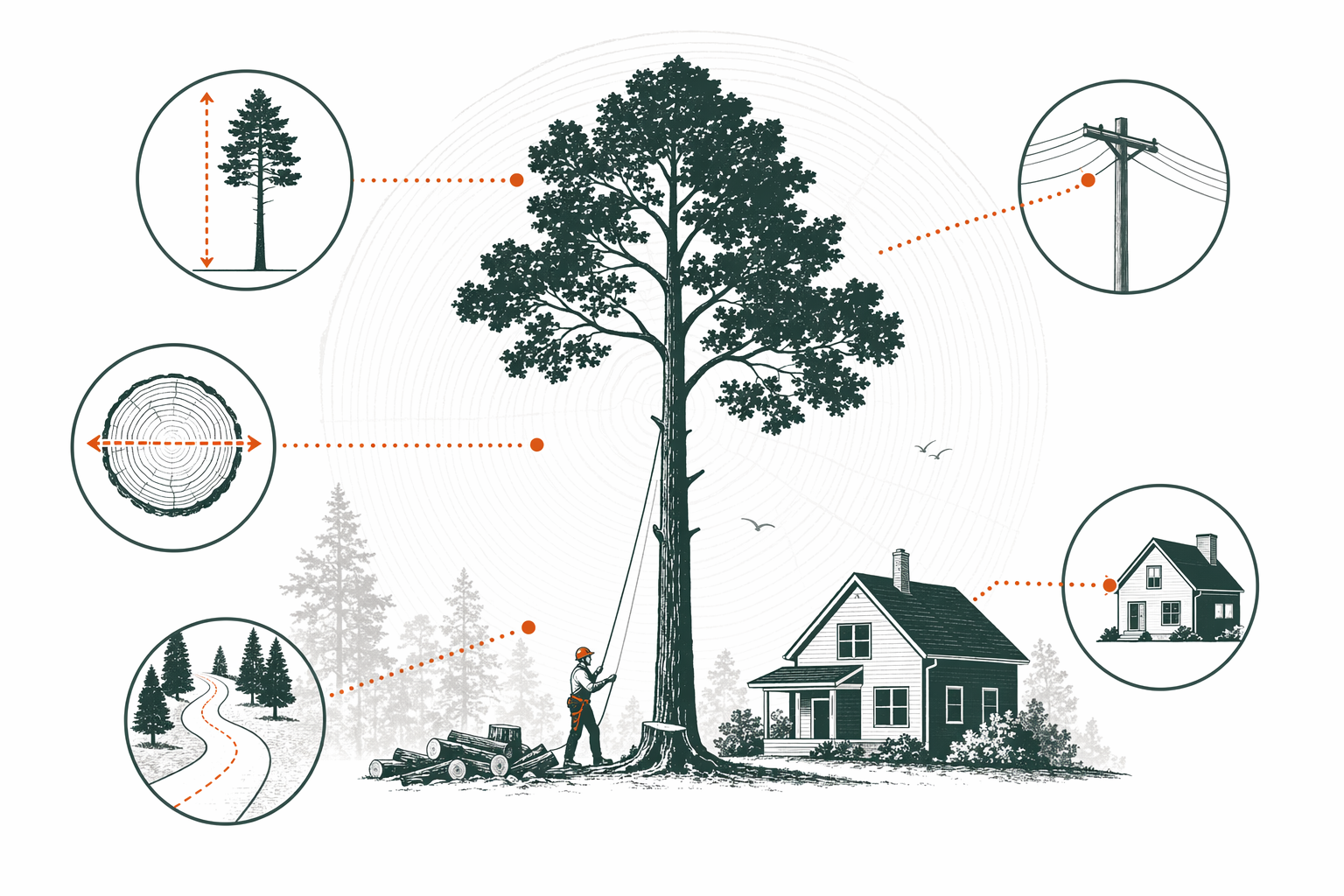
For a normal residential job in the US, tree removal often runs about $400 to $2,000+. Large trees, tight access, cranes, storm damage, or work near buildings and wires can push the price much higher. These are typical ranges and estimates, not quotes. The real price depends on the tree's size and species, its location and access, hazards, debris haul-away, and your area.
A few related services also affect the total:
- Trimming or pruning: about $250 to $1,200
- Stump grinding: about $100 to $500
- Emergency or storm cleanup: about $500 to $5,000+
If you are still deciding whether the whole tree needs to come down, it helps to learn the warning signs first. See signs of a hazardous tree and our general tree removal overview.
One more thing: TreelineLocal is a free matching service. We help you connect with licensed, insured tree companies. You compare estimates, choose who to hire, and hold the final payment until the agreed work is done.
What makes one tree cost $500 and another cost $3,000?
The biggest driver is usually risk. Tree work is dangerous, high-liability work. A simple open-yard removal is very different from taking down a cracked oak over a roof.
Here are the main things that raise or lower the price:
- Tree size and height. Taller trees usually take more crew time, more rigging, and more cleanup.
- Species and wood density. Some trees are heavier, harder to cut, or more brittle.
- Condition of the tree. Dead, split, hollow, storm-damaged, or leaning trees can be more hazardous to remove.
- Location. Near a house, fence, driveway, pool, septic area, shed, or neighbor's property usually means slower, more careful work.
- Access. If crews cannot get a truck, lift, or chipper close to the tree, labor goes up.
- Power lines and utilities. This is a major safety issue. A tree on or near electrical lines may require utility coordination and special procedures.
- Debris and haul-away. Some estimates include hauling every branch and log away. Others leave wood on site.
- Stump removal. Cutting a tree down and grinding the stump are often separate line items.
- Permit rules. Some cities and counties have rules for protected, street, or heritage trees. Permit time and paperwork can affect cost and timing.
- Local labor and disposal costs. Prices vary by region.
If a tree is downed or leaning on or near a power line, treat that as a life-threatening emergency. Stay back, keep other people away, and call the utility company and 911 first. Do not touch the tree, the wire, or anything the wire may be energizing. For more on storm situations, read storm damage tree safety.
What should be included in the estimate
A low number is not always a better deal. The job needs to be clearly described so you can compare one company with another.
Ask each company to put these details in writing:
- Exactly which tree is being removed. If there are several trees, each one should be listed.
- What is included. Full removal, limb removal only, haul-away, log cutting, brush chipping, site cleanup, and whether the stump is included.
- How they will protect the property. For example, plywood for lawn protection or a plan for tight spaces.
- Whether permits are needed. Local rules for protected or heritage trees may apply. Ask the company what they know, then verify with your city or county. This is general information, not legal advice.
- Proof of insurance and license details. Verify both yourself. Ask for general liability and workers' compensation coverage, and check the active license if your state or local area requires one.
- Who will do the work. For assessments, it is smart to prefer an ISA-certified arborist.
- Payment terms. Deposits vary, but never pay the full amount up front.
A careful estimate should also note any extra charges that may apply if the crew finds hidden problems, like a rotten trunk that requires a crane or traffic control.
Before you hire anyone, use a simple checklist like our guide on how to vet a tree company.
How homeowners save money without taking bad risks
There are honest ways to lower the bill. There are also dangerous shortcuts. Stick with the honest ones.
Ways to reduce the cost:
- Get 2 to 3 written estimates for the same scope.
- Be clear about debris. If you are okay keeping cut logs for firewood or mulch, ask whether that lowers the haul-away charge.
- Bundle work. If you also need pruning or stump grinding, ask for pricing at the same visit.
- Schedule non-emergency work before peak storm season when possible.
- Ask whether pruning is enough. Sometimes risk reduction can be done with trimming instead of full removal, depending on the tree's condition.
What not to do:
- Do not hire someone just because they knocked on your door after a storm.
- Do not trust vague promises like "we'll take care of everything" without a written scope.
- Do not pay cash up front to a storm-chasing crew.
- Do not let anyone start without proof of insurance.
- Do not assume the cheapest bid includes cleanup, haul-away, and stump grinding.
After storms, some crews move fast through neighborhoods and pressure homeowners. Be careful. Storm-chasing door-knockers who demand cash up front are a real risk. A legitimate company should be able to identify itself, explain the scope, and provide documentation.
If you want help finding companies to compare, get matched for free. Participating tree companies pay a flat fee to be listed with us. Homeowners pay nothing to use the matching service.
A simple step-by-step way to compare tree removal prices
Use this process to make the numbers easier to compare and to avoid getting burned:
- Take a few photos of the tree, the area around it, and access points like gates or driveways.
- Write down the problem. Dead tree, leaning tree, cracked limb, roots lifting concrete, storm damage, and so on.
- Ask for the same scope from each company. Example: remove one maple, haul away debris, leave logs cut into 18-inch sections, stump not included.
- Request license and insurance information in writing. Then verify it yourself.
- Ask if an ISA-certified arborist assessed the tree if the situation is not obvious.
- Compare line by line, not just bottom-line price. Look at cleanup, stump work, permit handling, and protection for your property.
- Do not pay the full amount up front. Keep final payment until the agreed work is completed.
If you are comparing several types of work, it also helps to review typical costs. The goal is not to chase the lowest number. The goal is to hire a licensed, insured company that clearly explains the work and does it safely.
Tree removal usually costs about $400 to $2,000+, but the real price depends on tree size, risk, location, access, cleanup, and your area. Get 2 to 3 written estimates, verify license and insurance yourself, prefer an ISA-certified arborist for assessments, never pay in full up front, and stay far away from any tree touching power lines.