How to tell if a tree is dangerous
Some tree problems are easy to miss until a branch drops or the whole tree starts to lean. Here is how homeowners can spot common danger signs, stay safe, and know when to call a licensed, insured tree company.
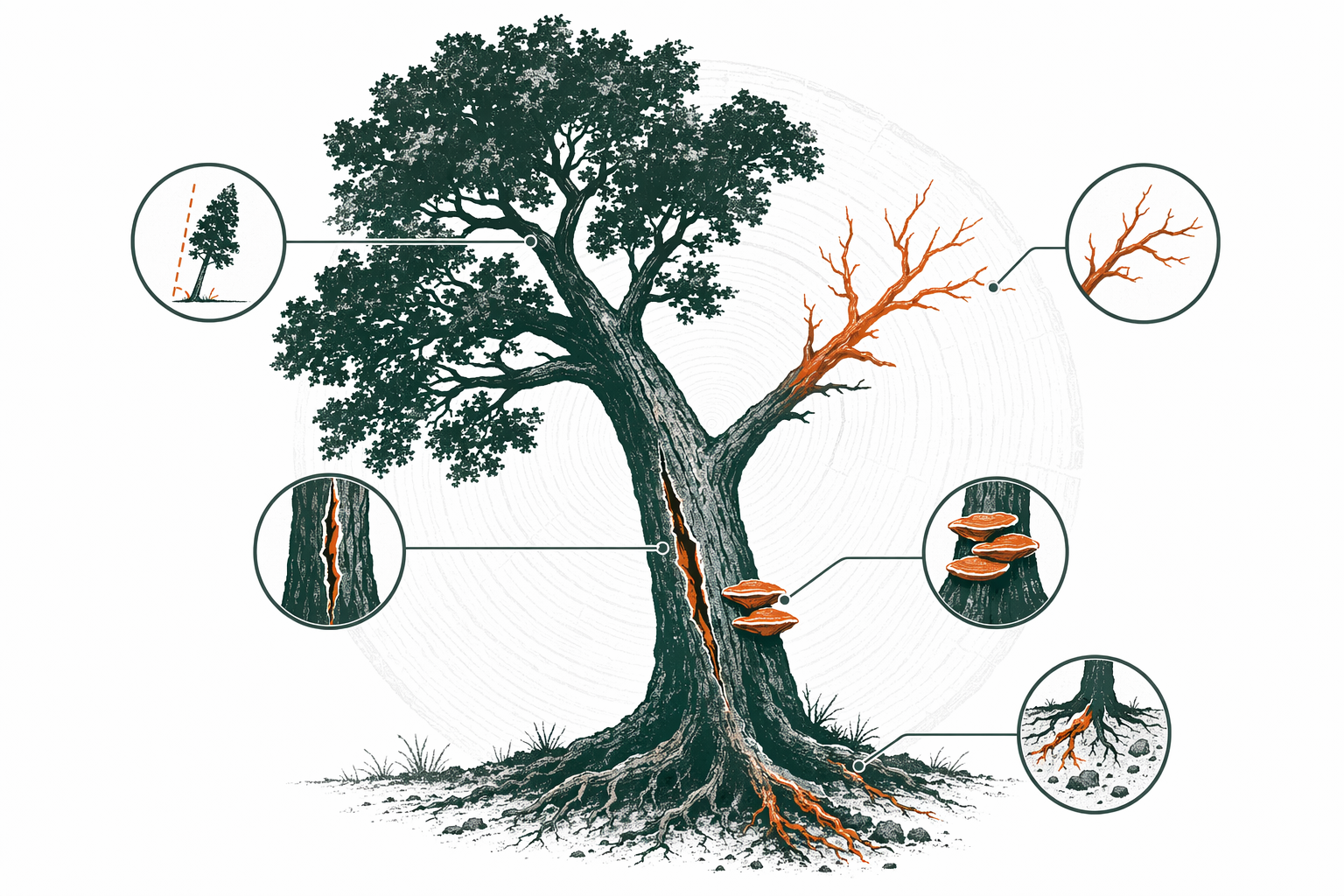
What makes a tree dangerous?
A dangerous tree is a tree that has a higher chance of failing and hurting people, damaging a home, blocking a driveway, or hitting cars, fences, or utility lines. That failure might be a falling branch, a split trunk, roots lifting out of the ground, or the whole tree coming down.
Not every dead branch means the whole tree must be removed. And not every leaning tree is an emergency. But some warning signs should make you take the situation seriously, especially after storms, long wet periods, drought, or construction around the roots.
The biggest factors are usually:
- Target: What could the tree hit if it fails? A tree over a play area, roof, driveway, sidewalk, or street is a bigger risk.
- Size: Bigger limbs and taller trees can cause more damage.
- Defects: Cracks, decay, cavities, weak branch unions, dead wood, and root problems matter.
- Change: A tree that suddenly leans, sheds large limbs, or drops bark may be getting worse.
- Location: Trees near buildings, roads, and especially power lines need more caution.
If you already see serious defects, it is smart to have the tree checked by an ISA-certified arborist and to hire only licensed and insured tree companies for any work. You should verify the company's license and insurance yourself, including liability coverage and workers' compensation, before work starts. For more detail on common risk clues, see signs of a hazardous tree.
Warning signs homeowners can often spot from the ground
You do not need to be an arborist to notice obvious red flags. Start with a slow walk around the tree from a safe distance.
Look at the trunk
- Long vertical cracks or fresh splits in the trunk
- Hollow spots, large cavities, or soft, crumbly wood
- Mushrooms or conks growing from the trunk or root flare, which can point to decay
- Bark falling off in large sections
- Old wounds that never closed and now look rotten
Look at the branches and crown
- Large dead branches with no leaves during the growing season
- Branches hanging, broken, or caught in the canopy
- One side of the canopy suddenly bare or thinning compared with the rest
- Branch unions with a tight V-shape and bark trapped inside, which can split under load
- Repeated limb drop, especially large limbs in calm weather
Look at the roots and soil
- Soil heaving, mounding, or cracking near the base
- Roots lifting out of the ground
- Fresh lean after a storm
- Construction damage, trenching, grade changes, or heavy equipment over the root area
- Rot, decay, or fungus around the root flare
Look for change, not just damage
A tree that has always leaned a little may be stable. A tree that just started leaning is different. A mature tree that suddenly looks thin, drops major limbs, or shows new cracks needs prompt attention.
A final point: a tree can still be risky even if it is alive and green. Full leaves do not cancel out trunk decay, root failure, or bad structure.
Danger levels: when to watch, when to act now
Use simple judgment here. The goal is not to diagnose the tree yourself. The goal is to know when to get help fast.
Call for prompt professional assessment if you notice:
- A new lean, especially after wind or heavy rain
- A crack in the trunk or a major limb union
- Large dead branches over a roof, walkway, or driveway
- Fungal growth at the base plus canopy decline
- Roots damaged by digging, paving, or recent construction
- A tree touching or growing very close to the house
Treat it like urgent danger if you notice:
- The root plate lifting or soil rising on one side
- A split trunk with visible separation
- A large branch broken and hanging over an occupied area
- A tree partly uprooted after a storm
- A tree leaning onto another tree and no longer standing on its own
Power-line warning: If a tree or branch is down, leaning, or tangled on or near a power line, stay back. Keep children, pets, and neighbors away. Call the utility company and 911 first. Do not touch the tree, the line, puddles nearby, or a fence that may be energized. Never try DIY work near lines.
If the tree is not a power-line emergency but looks unsafe, the next step is to get written estimates from qualified tree companies. TreelineLocal can help you get matched with licensed, insured local companies at no cost to you. The companies pay a flat fee to participate. You compare estimates, choose who to hire, and hold the final payment.
What to do next without making the situation worse
Here is a practical way to handle it.
- Keep people away from the risk area. Move cars if you can do so safely. Avoid standing under the tree.
- Take clear photos from the ground. Get the full tree, the base, cracks, dead limbs, and anything nearby that could be hit.
- Do not climb, cut, or tie off heavy limbs yourself. Tree work is dangerous and high-liability work.
- Get an assessment from an ISA-certified arborist when possible. For pruning, removal, cabling, or other work, hire a licensed and insured tree company and verify liability and workers' compensation yourself.
- Get the scope and price in writing before work begins. Never rely on a verbal promise.
- Do not pay the full amount up front. A deposit may be normal for some jobs, but final payment should wait until the agreed work is done.
Typical costs are estimates, not quotes. Real price depends on the tree's size and species, location and access, hazards, debris haul-away, and your area. Many homeowners see rough ranges like:
- Tree removal: $400-$2,000+
- Trimming or pruning: $250-$1,200
- Stump grinding: $100-$500
- Emergency or storm cleanup: $500-$5,000+
If you want a broader pricing overview, see tree work costs.
After storms, be extra careful with door-knockers who show up fast, demand cash, and push you to sign on the spot. Some storm chasers ask for full payment up front and disappear or do unsafe work. Slow down. Verify license and insurance yourself. Get it in writing.
Repair, pruning, or removal? And what about permits?
Not every hazardous tree needs removal. Sometimes the safer fix is targeted pruning, weight reduction, cabling, or removing one defective stem. Sometimes the right answer is full removal because the trunk, roots, or overall structure are too compromised.
A qualified professional should decide the options after seeing the tree in person. If you are comparing services, these pages may help:
Also remember that some cities and counties have rules for protected, heritage, or street trees. You may need approval before removing certain trees, even on private property. Rules vary by location. Ask the tree company what local permit process may apply, and confirm with your city or county if needed. That is general information, not legal advice.
The safest mindset is simple: if the tree could hit something important and you see real defects, do not wait for perfect certainty. Get it checked. Then compare written estimates, ask questions, and choose the company you trust.
If a tree has new leaning, cracks, dead large branches, root problems, or is near something important, treat it seriously. Stay back, never do DIY near power lines, and get written estimates from licensed, insured tree companies after verifying their coverage yourself.