Tree trimming and pruning
Tree trimming can make a tree safer, healthier, and easier to live with. The right crew matters. Bad pruning can damage a tree fast, and unsafe work can hurt people and property.
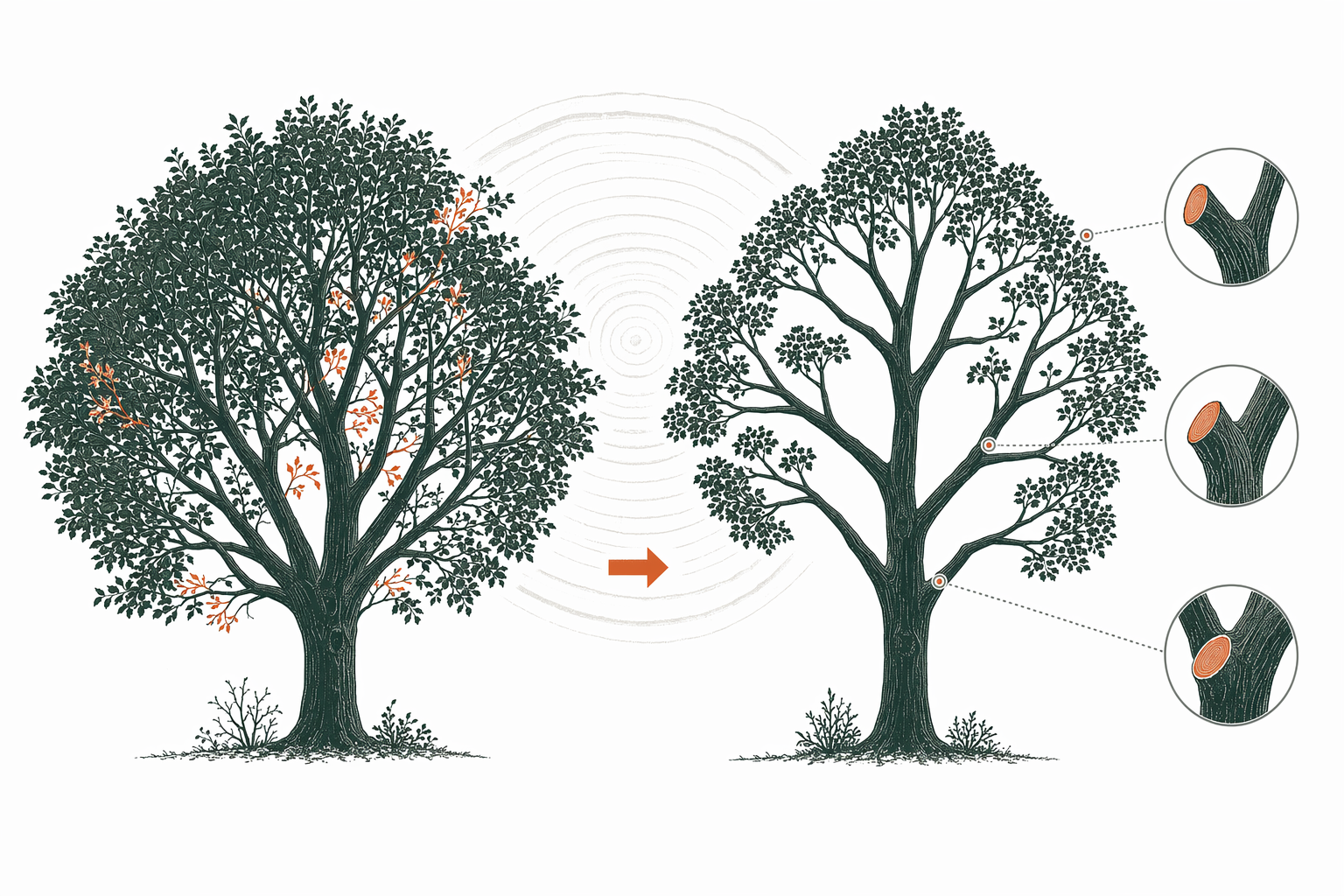
What tree trimming and pruning really means
Homeowners use these words loosely, but they usually mean careful cutting to remove dead, damaged, crowded, low, or overextended branches. The goal is not just to make a tree look neat. Good pruning can improve clearance, reduce some risk, and help a tree keep a sound structure.
A few common reasons people hire for this service:
- Branches rubbing the roof, fence, or siding
- Limbs hanging over a driveway, sidewalk, or play area
- Deadwood after a storm or hard winter
- Thick growth blocking light or visibility
- Young trees that need structure training
- Broken or split limbs that may fail later
Not every tree should be cut back heavily. In fact, over-pruning is one of the biggest mistakes homeowners pay for. Topping, lion-tailing, and random deep cuts can stress the tree, invite decay, and lead to weak regrowth. That is why it is smart to prefer an ISA-certified arborist for the assessment, especially if the tree is large, old, valuable, or showing signs of decline.
If you are not sure whether your tree needs trimming or something more serious, review common warning signs on hazardous tree issues. If the job is basic maintenance, learn more about this service at tree trimming and pruning.
Typical cost to trim or prune a tree
For most homeowners, typical trimming and pruning costs run about $250 to $1,200 per tree. Small ornamental trees may be less. Large, high-canopy, difficult, or hazardous trees can cost more.
These are estimates, not quotes or guarantees. The real price depends on:
- Tree size and species: Taller trees and hardwoods usually cost more.
- Location and access: Tight backyards, fences, steep slopes, and limited truck access raise labor time.
- Hazards: Dead limbs, storm damage, decay, nearby structures, and rigging needs increase risk.
- How much is being removed: Light cleanup is cheaper than major canopy reduction.
- Debris haul-away: Chipping, hauling, and cleanup affect the final number.
- Your area: Labor and disposal costs vary by region.
Rough examples:
1. Small front-yard tree with light shaping: $250-$500
2. Medium shade tree with deadwood removal and clearance pruning: $500-$900
3. Large mature tree needing climbing, rigging, and full cleanup: $900-$1,200+
If a company says a price without seeing the tree, be careful. A real number usually requires an on-site look. Get the scope in writing so you can compare apples to apples. You can also review broader tree-work cost ranges before you talk to companies.
How the work is usually done
A professional tree company should explain the plan in plain language before they cut anything. Good pruning is selective. It is not just removing as many branches as possible.
A typical job may include:
1. Assessment: The crew or arborist checks species, size, branch structure, defects, clearance needs, and site hazards.
2. Work plan: They identify which limbs will be removed and why, such as deadwood, crossing limbs, low clearance, or end-weight reduction.
3. Site protection: They set cones, manage drop zones, and protect roofs, fences, landscaping, and walkways as needed.
4. Climbing or lift access: Depending on the site, they may climb with ropes and saddles or use a bucket truck where access allows.
5. Proper cuts: Branches should be cut at the right points to reduce damage and help the tree seal over time.
6. Cleanup: Confirm whether brush hauling, chipping, log removal, and final raking are included.
Ask simple, direct questions:
- What exactly will you cut?
- About what percentage of the canopy will be removed?
- Will you shape the tree naturally, or are you reducing height?
- Is haul-away included?
- Who is responsible if the lawn, driveway, or irrigation gets damaged?
A good company should be able to answer clearly, without pressure. If they recommend extreme cutting for a healthy tree, get another opinion.
Important safety note: If a limb or tree is touching, leaning on, or down near a power line, stay back and keep others away. That is a life-threatening emergency. Call the utility company and 911 first. Do not touch the tree, the limb, the fence, or anything nearby. For urgent post-storm issues, read storm damage tree safety.
How to hire the right tree company
This is where many homeowners get burned. Tree work is dangerous and high liability. The cheapest bid is not always the safe bid.
Use this checklist before you hire anyone:
- Hire a licensed and insured tree company. Verify the license yourself if your state or city requires one.
- Ask for proof of insurance. Check both general liability and workers' compensation. Verify that the coverage is active.
- Prefer an ISA-certified arborist for the assessment, especially for mature trees, high-value trees, and any tree with defects or decline.
- Get the scope in writing. The written estimate should say what branches are being removed, whether haul-away is included, and what cleanup looks like.
- Compare at least two or three written estimates. You compare the options. You choose who to hire.
- Ask about permits if relevant. Some cities and HOAs have rules for protected, heritage, street-adjacent, or certain native trees. Rules vary. Check local requirements before work starts.
- Do not pay the full amount up front. A deposit may be normal on some jobs, but hold final payment until the agreed work is done.
- Watch for storm-chasing door-knockers. After a storm, some crews go street to street, demand cash, and disappear after poor work.
Red flags include no written estimate, no insurance proof, pressure to decide now, and vague answers like "we'll trim it however you want" without discussing tree health or safety.
If you want help finding local companies to compare, you can get matched for free. TreelineLocal is a free matching service. Participating tree companies pay a flat fee. You still compare estimates, choose the company, and control final payment.
When trimming is not enough
Sometimes a tree does not need pruning. Sometimes it needs a different service.
Trimming may not be the right fix when:
- The trunk is cracked or splitting
- Major roots are lifting, severed, or decayed
- The tree is dead or mostly dead
- The tree is leaning more than before, especially after rain or wind
- Large limbs are already hanging or partially broken
- There is severe decay at the base or in main branch unions
In those cases, ask whether the tree may need tree removal or emergency work instead of routine pruning. If the tree has already failed in a storm or is blocking access, emergency service may be the right category. Either way, the safest path is an on-site evaluation by a licensed, insured company, with an ISA-certified arborist preferred for the assessment.
Also remember that trimming cannot solve every problem. Cutting back branches away from a house may reduce contact, but it will not fix root damage, decay, or structural weakness. A clear explanation in writing matters just as much as the price.
Tree trimming usually costs about $250 to $1,200 per tree, depending on size, access, hazards, cleanup, and your area. Hire a licensed and insured tree company, verify liability and workers' comp yourself, prefer an ISA-certified arborist for the assessment, get the work in writing, and never pay the full amount up front.