Tree removal — what it costs and how it's done safely
Tree removal is dangerous, high-liability work. This guide explains the usual cost range, what affects the price, how the job is usually done, and how to hire a licensed, insured tree company safely.
When tree removal makes sense
Sometimes a tree should stay and be trimmed. Sometimes it really does need to come down. A removal may be needed when a tree is dead, badly decayed, split, leaning more than before, dropping large limbs, damaging a foundation, or growing in a spot where it creates serious risk.
A good first step is to get an assessment from a licensed and insured tree company and, when possible, prefer an ISA-certified arborist for the evaluation. Ask what they see, what risks they found, and whether trimming, cabling, monitoring, or removal is the better option.
Common reasons homeowners remove a tree:
- The tree is dead or dying and likely to fail
- The trunk is cracked, hollow, or has major decay
- Roots are causing major damage or instability
- The tree is too close to the house, garage, or driveway for safe growth
- Storm damage made the tree unsafe
- Construction or drainage changes harmed the tree
If you are not sure whether the tree is truly hazardous, read signs of a hazardous tree and then get professional estimates. TreelineLocal is a free matching service. We help you connect with licensed, insured tree companies. You compare estimates, choose who to hire, and hold the final payment.
Typical tree removal cost
For most homeowners, tree removal usually runs about $400-$2,000+. Large, difficult, or high-risk jobs can cost more. That is a typical range, not a quote or guarantee.
Real price depends on:
- Size and species of the tree
- Location and access on the property
- Nearby hazards like roofs, fences, sheds, pools, or tight yards
- Whether a crane, bucket truck, or extra rigging is needed
- Debris haul-away and cleanup level
- Whether the stump stays or needs grinding
- Your area and local labor costs
Here is a practical way to think about pricing:
1. Small tree, easy access: often at the lower end of the range
2. Medium tree near structures: commonly mid-range
3. Large tree, tight drop zone, heavy rigging: often higher
4. Emergency or storm work: usually costs more because of urgency and hazard
Related services often price separately:
- Trimming and pruning: about $250-$1,200
- Stump grinding: about $100-$500
- Emergency or storm cleanup: about $500-$5,000+
Ask each company exactly what is included. Some estimates include cutting, lowering limbs, haul-away, raking, and log removal. Others leave wood on site or price stump grinding separately. Get the full scope and price in writing before work starts. Never pay the full amount up front.
For broader pricing help, see tree-work costs and stump grinding.
How tree removal is usually done
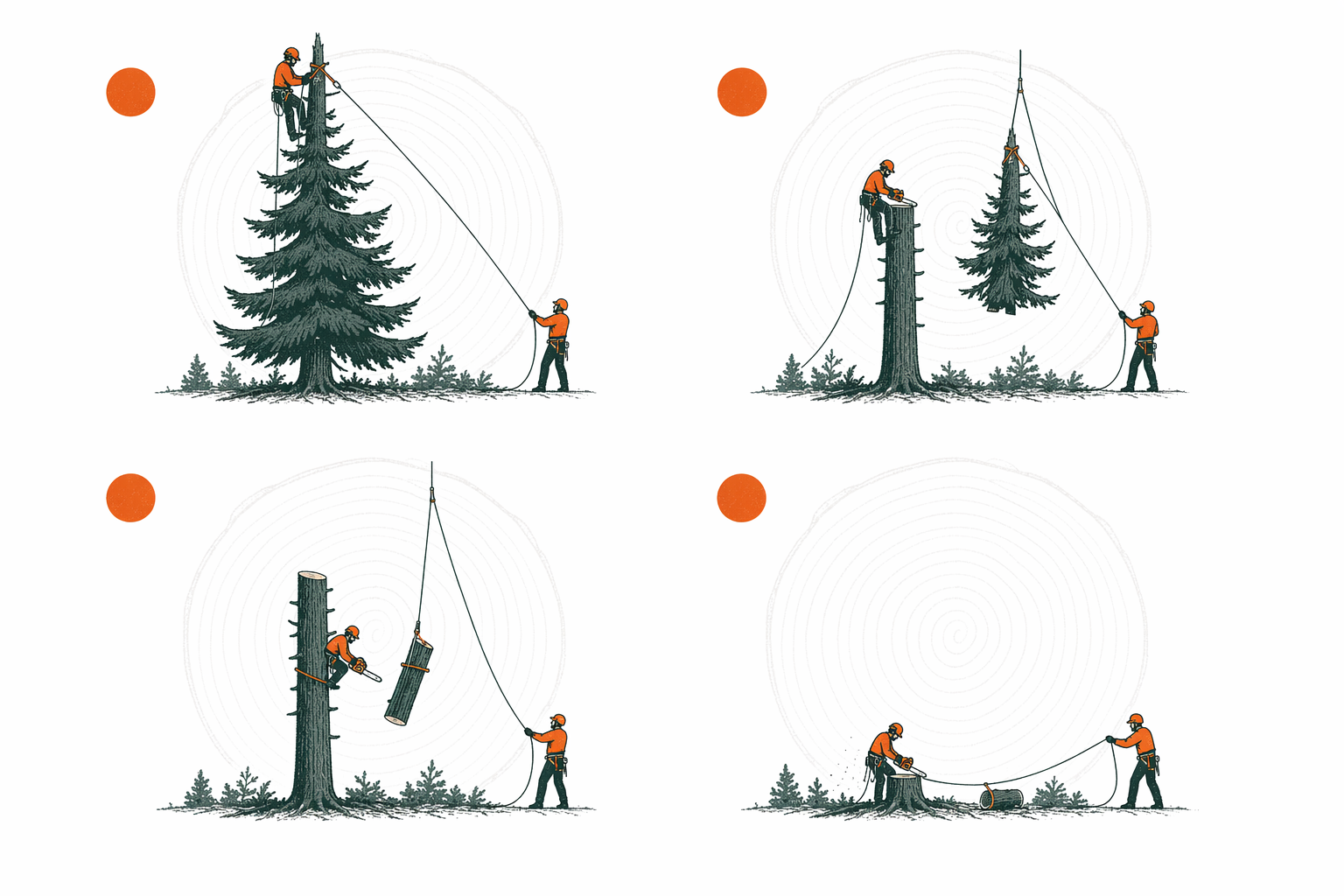
Tree removal is not just "cut it down." On many properties, the tree must be taken apart in sections so it does not hit the house, fence, cars, or landscaping.
A professional crew will usually:
1. Inspect the tree and the site. They look at lean, decay, power lines, nearby structures, access for trucks, and safe work zones.
2. Set up safety and equipment. This can include ropes, rigging, saws, traffic cones, plywood to protect the lawn, and sometimes a bucket truck or crane.
3. Remove limbs first. Branches may be cut and lowered in pieces, especially in tight spaces.
4. Take down the trunk in sections. Large trees are often dismantled from the top down.
5. Cut the main stem into rounds. Wood may be hauled away, stacked, or left on site if you request it.
6. Clean up debris. Ask whether raking and small-branch cleanup are included.
7. Grind the stump if selected. This is often a separate service.
Important safety note: if a tree is down, leaning, or hanging on or near a power line, stay back, keep others away, and call the utility company and 911 first. Treat it as a life-threatening emergency. Do not touch the tree, the wire, or anything the wire may be energizing. Do not try DIY work near lines.
For urgent storm situations, read storm-damage tree safety and consider emergency tree service.
How to hire the right tree company
This is where many homeowners get burned. The cheapest number is not always the lowest real cost if the crew is uninsured, damages your property, or disappears after taking a deposit.
Use this checklist:
- Hire a licensed and insured tree company
- Verify the license and insurance yourself. Ask for proof of general liability and workers' compensation coverage
- Prefer an ISA-certified arborist for the assessment, especially for questionable removals or high-value trees
- Get 2-3 written estimates so you can compare scope, cleanup, stump work, and timeline
- Ask whether they use employees, subcontractors, or both
- Confirm who handles permits if your city or town has rules for protected or heritage trees
- Ask what happens if extra decay, equipment needs, or access problems are discovered on site
- Keep final payment until the agreed work is complete
Red flags:
- Door-knockers after a storm who say they are "working nearby"
- Pressure to sign now
- Cash-only demands
- A request for full payment up front
- No written scope
- No proof of insurance
Permit rules can matter. Some cities and towns restrict removal of protected, street, or heritage trees, even on private property. Always ask the company what local rules may apply and verify with your municipality if needed. That is general information, not legal advice.
If you want help finding companies to compare, use get matched or read how to vet a tree company. TreelineLocal does not do tree work. Matching is free to the homeowner. Participating tree companies pay a flat fee to take part.
Questions to ask before you say yes
A clear estimate protects you. Before hiring, ask these practical questions:
- What exactly are you removing?
- Is haul-away included?
- Is stump grinding included or separate?
- Will you protect the lawn, driveway, fence, and flower beds?
- Do you need special equipment like a crane or bucket truck?
- How long should the job take?
- Who is responsible for permits if required?
- What is the payment schedule?
- What is excluded from the price?
A strong written estimate should include:
1. Company name and contact details
2. Proof of license status and insurance information
3. Exact work scope
4. Cleanup details
5. Stump details
6. Total price or clear pricing method
7. Estimated start window
8. Payment terms
If a company is vague on safety, insurance, or cleanup, keep shopping. Homeowners usually do best when they compare a few written estimates side by side rather than deciding on the spot.
If a tree may need removal, get 2-3 written estimates from licensed and insured tree companies, verify insurance yourself, prefer an ISA-certified arborist for the assessment, and never pay the full amount up front. If the tree is on or near a power line, stay away and call the utility company and 911 first.