Emergency and storm-damage tree service
Storm-damaged trees can turn dangerous fast. TreelineLocal is a **free matching service** that helps you understand the job and compare licensed, insured tree companies you choose from.
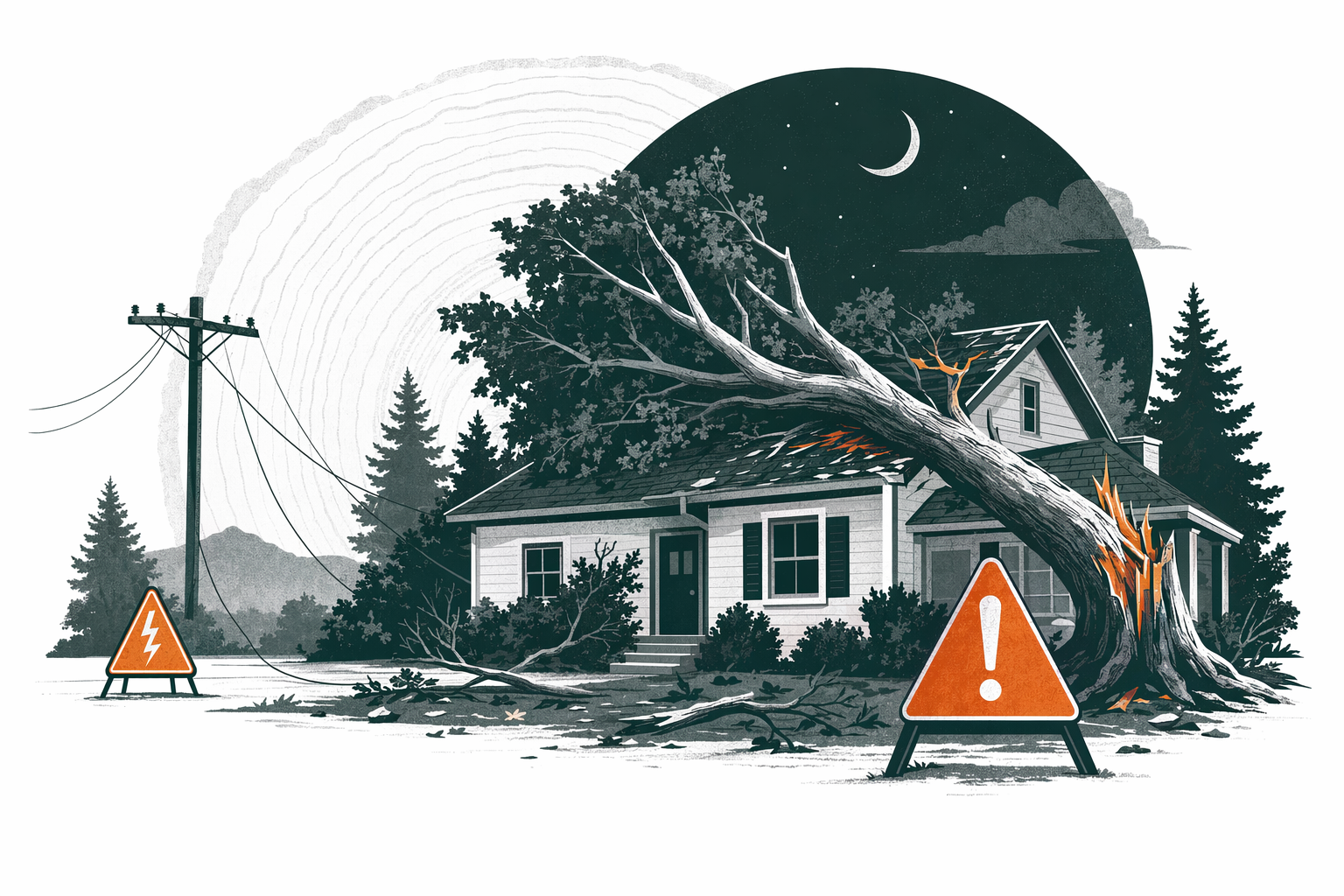
What counts as an emergency tree job
An emergency tree job is usually about immediate danger, not just inconvenience. After a storm, a tree may be cracked, uprooted, hanging over a roof, blocking a driveway, or leaning toward people, cars, or utility lines.
Some storm damage can wait a day or two for a normal appointment. Some cannot. The high-risk situations are the ones that can injure someone or cause more damage if the tree moves again.
Treat it as urgent if:
- A tree or large limb is on or near a power line
- The trunk is split or the root plate has lifted and the tree is leaning more than before
- A broken limb is hanging overhead
- A tree is on a home, garage, fence, vehicle, or blocking an entry route
- The tree is cracked after wind, ice, or lightning and could fail again
Safety first: if a tree is downed or leaning on or near a power line, stay back, keep others away, and call the utility company and 911 first. Do not touch the tree, the wire, a fence, or anything the wire may be energizing. Do not try DIY cutting near lines.
If the situation is not life-threatening but still serious, it helps to review basic storm precautions before you call companies. See storm-damage tree safety.
Typical emergency tree service costs
Emergency tree work usually costs more than scheduled work because it often involves after-hours response, storm conditions, added hazards, rigging, cranes, traffic control, roof protection, or urgent debris removal.
These are typical ranges and estimates, not quotes or guarantees. The real price depends on the size and species of the tree, its location and access, hazards, debris haul-away, and your area.
- Emergency or storm cleanup: about $500-$5,000+
- Tree removal: about $400-$2,000+, with very large or complex removals higher
- Limb or branch removal after storm damage: often falls into trimming/pruning pricing, roughly $250-$1,200, but urgent hazardous work can run higher
- Stump grinding later: about $100-$500
What pushes the price up:
- Nights, weekends, and peak storm demand
- Tree on a house, car, or structure
- Crane use or advanced rigging
- Limited yard access or tight urban lots
- Large hardwoods or multiple damaged trees
- Full debris haul-away and cleanup
What can lower the bill:
- The tree is small and easy to reach
- The company can do the work in daylight, not overnight
- You separate the urgent safety work from non-urgent cleanup
- You keep some wood or chips if the company offers that option
A common storm-day mistake is agreeing to a number on the spot with no written scope. Get the scope and price in writing before any work when possible, even in an emergency. And never pay the full amount up front. If you want a broader look at pricing, see tree work costs.
What to do right after storm damage
When a tree comes down or starts to fail, slow down and handle the first hour in order.
- Protect people first. Keep family, neighbors, pets, and drivers away from the area.
- Watch for power hazards. If any part of the tree is touching or near a line, call the utility company and 911 first.
- Do not climb, cut, or pull on the tree. Storm-loaded wood can spring, roll, or drop without warning.
- Take photos from a safe distance. This helps with insurance and with explaining the job to companies.
- Stop new interior damage if you can do it safely. For example, place a bucket under a roof leak. Do not go onto a damaged roof under a tree.
- Call your homeowners insurance carrier if a tree hit a covered structure. Ask what documentation they want.
- Get matched with licensed, insured tree companies for the hazardous tree work. TreelineLocal can help at get matched.
If the tree is only dropping small debris in the yard and there is no target nearby, the job may not need an emergency rate. But if the tree is split, hanging, uprooted, or over a home, this is not a casual cleanup job.
Also be careful after major storms. Storm-chasing door-knockers often show up fast and demand cash up front. That is a red flag. A legitimate company should be able to show license information if your state or locality requires it, proof of liability insurance and workers' compensation, and a written work order.
How emergency tree work is usually done
Every storm job is different, but the process is usually more controlled than homeowners expect. Good crews focus on making the site safe first, then removing weight in a sequence that avoids more damage.
A typical job may look like this:
- Assessment of hazards. The crew identifies unstable wood, roof contact points, utility issues, access limits, and safe drop zones. For the assessment itself, it is smart to prefer an ISA-certified arborist when available.
- Site protection. Cones, ropes, plywood, rigging lines, or equipment placement may be used to protect structures and manage debris.
- Piece-by-piece removal. Instead of cutting the whole tree at once, damaged sections are often lowered in smaller pieces.
- Debris handling. Brush is chipped, wood is stacked or hauled away, and the site is cleared enough to reduce immediate risk.
- Follow-up work if needed. Some emergency visits only make the site safe. Full removal, pruning, or stump grinding may be scheduled after.
A few things homeowners should know:
- Emergency stabilization is not always the whole job. You may pay first for hazard reduction, then later for complete removal or pruning.
- Permits may still matter. Some cities and towns have rules for protected or heritage trees, even after storm damage. Ask the company what local rules may apply. This is general information, not legal advice.
- Not every damaged tree needs removal. A qualified professional may recommend pruning, cabling support, monitoring, or removal depending on the damage. If you are unsure whether a tree is still dangerous, read signs of a hazardous tree.
How to hire the right company when you are under pressure
Storm damage is when people get rushed into bad decisions. The right hire is not always the first truck in the neighborhood.
Hire a company, not a promise. Verify everything yourself.
Use this checklist:
- License: If your state or local area requires a license, ask for the license number and verify it yourself.
- Insurance: Ask for current proof of general liability and workers' compensation. Verify both yourself.
- Qualifications: Prefer an ISA-certified arborist for the assessment, especially on high-value or borderline save-vs-remove trees.
- Written scope: Make sure the agreement says exactly what they will do, what debris they will remove, whether stump work is included, and what happens if more damage is found.
- Price terms: Get the price in writing before work starts when possible. Do not pay the full amount up front.
- Safety approach: Ask how they will protect your roof, driveway, fence, and landscaping.
- Equipment plan: If a crane or large equipment is needed, ask whether permits or traffic control are part of the scope.
Good questions to ask:
1. Is this visit for temporary hazard reduction, full removal, or both?
2. Is haul-away included?
3. Who is responsible for protecting the roof tarp area, siding, fence, or lawn?
4. Will you provide a certificate of insurance?
5. What could change the final price?
TreelineLocal does not perform tree work. We are a free matching service. Participating tree companies pay a flat fee to be listed and connected. You compare estimates, you choose who to hire, and you hold the final payment. If you want help checking a company before you sign, read how to vet a tree company.
What emergency service usually includes, and what it may not
Homeowners often assume the emergency crew will do everything in one visit. Sometimes they do. Sometimes they should not.
Usually included in emergency response:
- Hazard assessment
- Cutting and removing the dangerous portion of the tree
- Basic site cleanup for immediate safety
- Haul-away if listed in writing
May be separate or extra:
- Full tree removal after initial stabilization
- Stump grinding
- Roof repair, tarp work, gutter repair, or siding repair
- Fence repair
- Log splitting or firewood cutting
- Extra trips for non-urgent cleanup
If the tree hit your house, your tree company and your insurance carrier may both need photos and written notes. Keep all paperwork. Ask for an invoice that clearly separates emergency mitigation from later work.
If you are already sure the tree must come down, it may help to review the standard process on tree removal.
If a storm-damaged tree is near people, your home, or power lines, treat it seriously. Stay back, call the utility company and 911 first for line hazards, then compare written estimates from licensed, insured tree companies you verify yourself. TreelineLocal can help you get matched for free.