ISA-certified arborist vs. a handyman with a chainsaw
Not every tree job needs the same level of skill. But tree work is high-risk, and hiring the wrong person can cost you a lot more than you save.
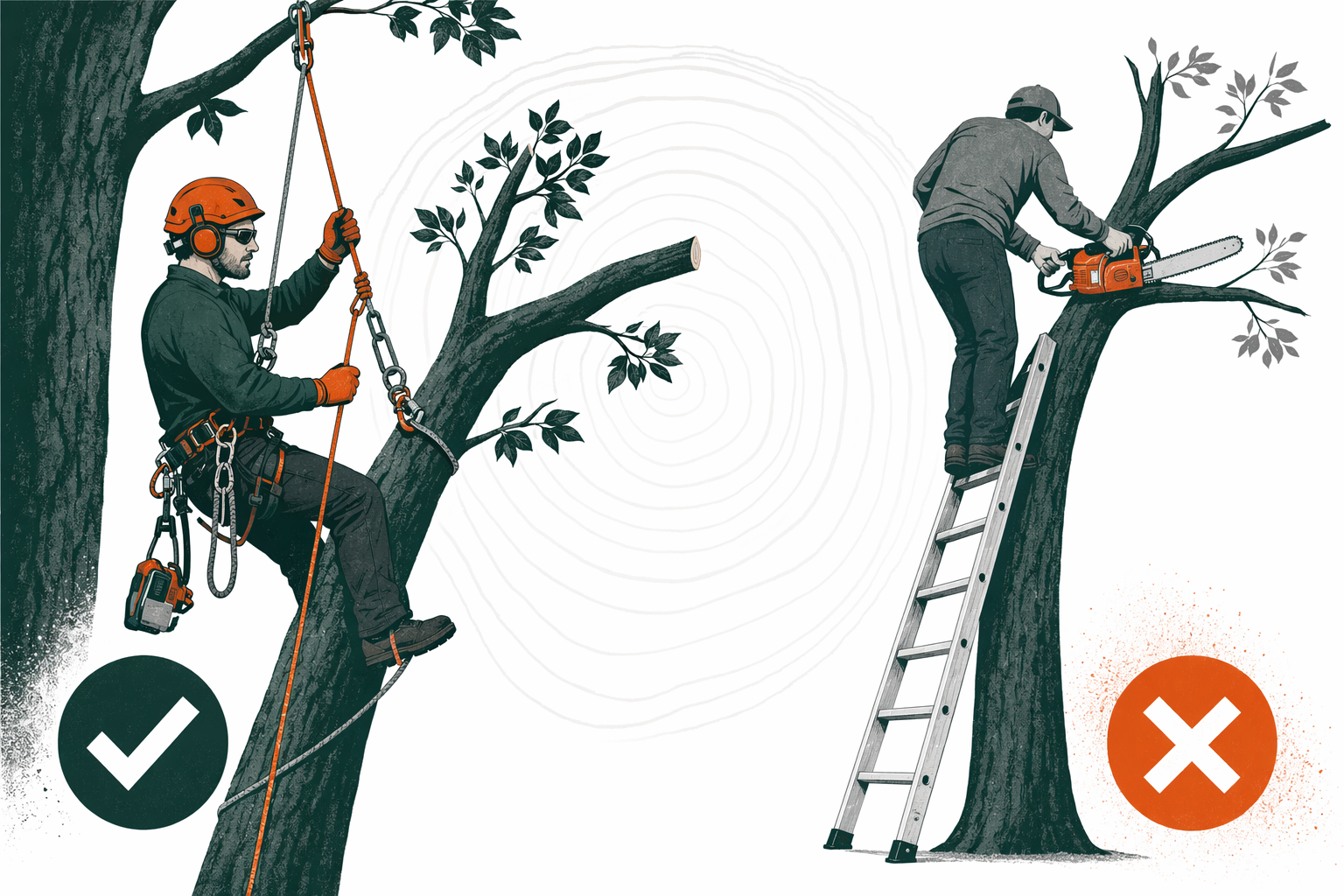
The short answer
A handyman may be fine for small, low-risk yard tasks. Tree work is different. Cutting limbs overhead, working near roofs, fences, sheds, sidewalks, and especially power lines can turn into a serious injury or property-damage claim fast.
An ISA-certified arborist is trained in tree biology, pruning methods, hazard evaluation, and safer work practices. That matters when the question is not just "Can someone cut it?" but also "Should it be cut, how much, and what could go wrong?"
If you are dealing with a dead tree, a cracked trunk, large hanging limbs, roots affecting structures, or a tree close to a house, start with a qualified assessment. TreelineLocal is a free matching service that helps you compare local tree-care companies. You can get matched and choose who to hire.
If a tree is down on or leaning into a power line, stay back, keep others away, and call the utility company and 911 first. Do not touch the tree, the wire, or anything the wire may be energizing.
What an ISA-certified arborist brings that a handyman usually does not
Here is the practical difference for a homeowner:
- Training in tree care: An ISA-certified arborist is tested on pruning, tree health, cabling/bracing concepts, risk awareness, and proper tree-care standards.
- Better judgment on scope: Sometimes a tree does not need removal. Sometimes it does. A trained arborist is more likely to explain options clearly.
- Safer pruning choices: Bad cuts can weaken a tree, cause decay, or create future hazards.
- Risk awareness around structures: Large limbs over a roof or driveway need planning, rigging, and controlled lowering.
- Documentation: Reputable companies usually give a written scope, proof of insurance, and clear cleanup terms.
A handyman with a chainsaw may offer a lower number because they are not carrying the same insurance, crew, equipment, or training. That lower price can be expensive if:
- A limb hits your roof or car.
- A worker gets hurt on your property.
- The tree is cut incorrectly and becomes more dangerous later.
- You end up paying a second company to fix the first job.
For pruning and maintenance, see typical trimming and pruning ranges and job types. Typical costs are estimates only, not quotes. Real price depends on the tree's size and species, location and access, hazards, debris haul-away, and your area.
When a handyman is the wrong choice
In many cases, a handyman is simply not the right hire.
Do not use a general handyman for:
- Tree removal larger than a small ornamental tree
- Work that requires climbing or ropes
- Limbs over a house, garage, fence, pool, driveway, or street
- Trees with visible cracks, hollow areas, or major lean
- Storm-damaged trees with broken or hanging limbs
- Any work near service drops or power lines
- Jobs where permits may apply, such as protected or heritage trees in some cities
For these jobs, hire a licensed and insured tree company and verify the license and insurance yourself. Ask for current proof of:
- General liability insurance
- Workers' compensation insurance
- Any required state or local license
Also ask who will actually do the work. Some sellers hand the job to an uninsured subcontractor. Get the exact scope, cleanup, debris haul-away, stump work, and price in writing before work starts. Do not pay the full amount up front.
If you think a tree may be unsafe, review common warning signs on signs of a hazardous tree.
What jobs might be okay for a handyman
There are a few situations where a handyman may be reasonable, but keep the limits tight.
A handyman may be okay for:
- Hauling small brush piles already cut and lying on the ground
- Light yard cleanup far away from structures and wires
- Very small shrubs or minor non-tree tasks
Even then, use caution. If a chainsaw is coming out, the risk rises quickly. Many homeowners hear "It will only take 20 minutes" and assume the job is simple. That is how people get burned.
A fair question to ask is: If something goes wrong, who pays? If the answer is unclear, keep looking.
Typical price ranges to keep in mind:
- Tree removal: about $400-$2,000+, with large or complex jobs higher
- Trimming/pruning: about $250-$1,200
- Stump grinding: about $100-$500
- Emergency or storm cleanup: about $500-$5,000+
Those are typical ranges only. They are not bids or guarantees. You can compare more examples on the costs page.
How to choose the right pro and protect yourself
Use this simple process:
- Start with the risk level. Is the tree large, damaged, leaning, over a structure, or near a line? If yes, do not shop this like basic yard work.
- Prefer an ISA-certified arborist for assessments. This is especially helpful when you are deciding between pruning, removal, or monitoring.
- Verify license and insurance yourself. Do not rely on a verbal "Yes, we are covered."
- Get 2-3 written estimates. You compare them. You choose who to hire.
- Read the scope closely. Does it include haul-away, stump grinding, traffic control, and cleanup?
- Ask about permits. Some cities and HOAs have rules for protected, street, or heritage trees. Get local information before removal. This is general information, not legal advice.
- Control payment. A deposit may be normal on some jobs, but never pay the full amount up front. Hold final payment until the agreed work is done.
After storms, be extra careful. Watch for door-knockers who say they "were just in the neighborhood" and want cash right now. That is a classic storm-chasing tactic. For urgent situations, learn the basics on storm damage tree safety. If you need help finding local companies, TreelineLocal can match you for free.
If a tree job is high off the ground, near your house, damaged, or near power lines, skip the handyman and hire a licensed, insured tree company. Prefer an ISA-certified arborist for the assessment, verify insurance yourself, get the job and price in writing, and never pay all the money up front.