Stump grinding vs. full removal vs. leaving it
After a tree comes down, the stump is the next decision. In many yards, **stump grinding** is the practical middle ground, but sometimes full removal makes sense, and sometimes leaving it is fine.
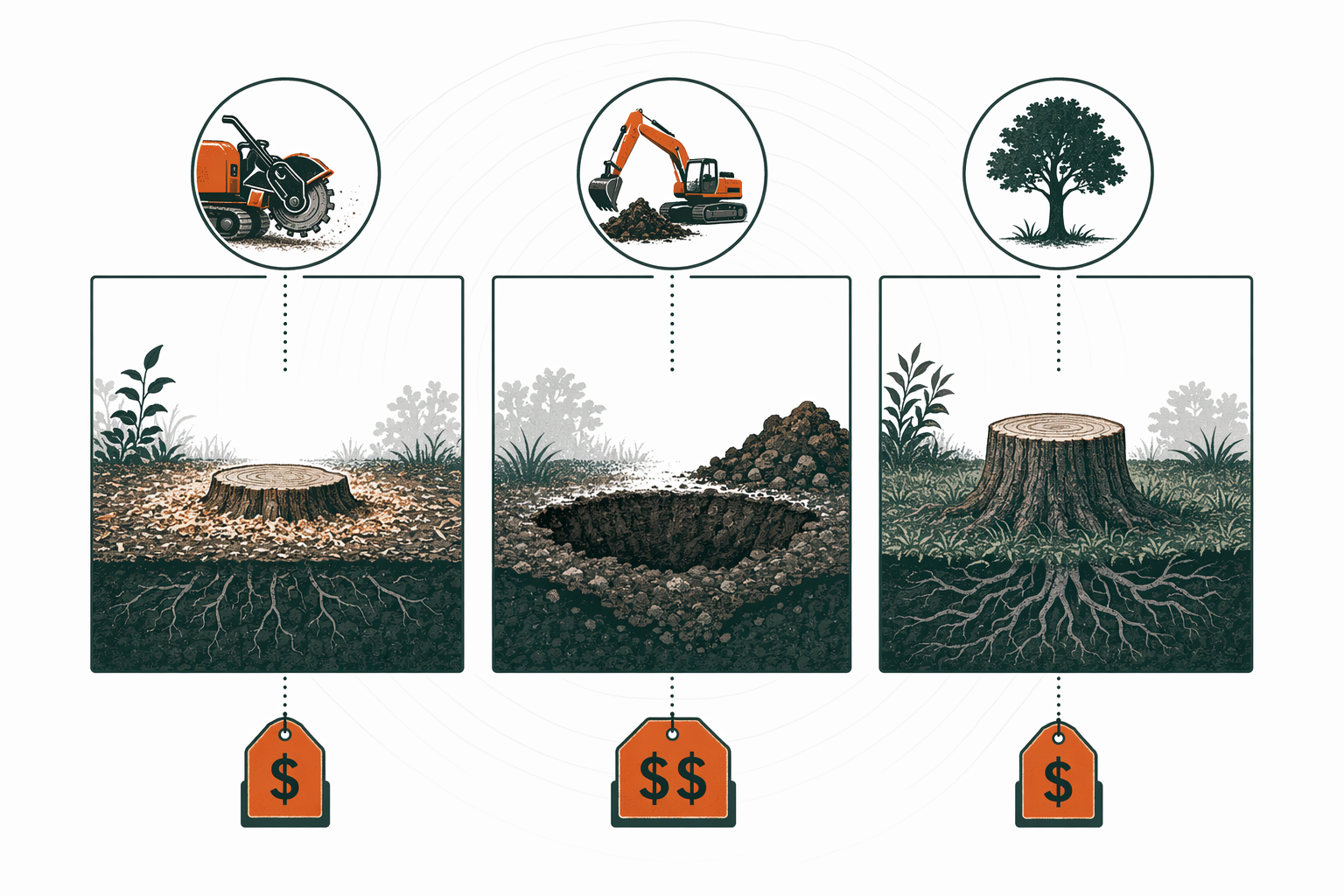
What each option really means
Homeowners often hear three choices after tree removal: grind the stump, remove the stump completely, or leave it alone. These are not the same job.
Stump grinding means a tree company uses a machine to grind the stump down below grade, often a few inches to about a foot or more depending on the job and your plans for the area. The major roots usually stay in the ground and decay over time. This is why grinding is often faster and less expensive than full removal. Learn more about typical stump grinding costs and what affects the price.
Full stump removal usually means pulling out the stump and the main root flare, and sometimes excavating larger roots near the surface. This is more invasive. It can leave a larger hole, disturb lawn or irrigation, and require more cleanup and fill soil.
Leaving it means exactly that. The stump remains in place and slowly breaks down over several years. That can be acceptable in a back corner of a property, but it can also create mowing problems, insect habitat, and tripping issues.
The right choice depends on how you want to use the area, the stump size and species, access for equipment, nearby hardscape, underground utilities, and your budget. Real prices are typical ranges only, not quotes. In many areas, stump grinding runs about $100-$500 for a typical stump, while full removal may cost more because of labor, excavation, haul-away, and repair work. The actual price depends on the size and species of the tree, its location and access, hazards, debris haul-away, and the area.
When stump grinding is usually the best fit
For many homeowners, grinding is the best balance of cost, appearance, and speed.
Here is when grinding often makes sense:
- You want the stump gone from sight. Grinding lowers it below the lawn line so the area looks cleaner.
- You do not want major yard damage. Grinding usually disturbs less soil than pulling the whole stump.
- You want a lower-cost option. It is often cheaper than full removal, especially for larger stumps.
- The stump is near fences, patios, driveways, or other features. Full extraction can damage nearby surfaces or require more demolition.
- You just want to reseed or cover the area with mulch. Grinding is often enough for basic landscaping.
But grinding has limits. The roots usually remain underground. Some species may still send up sprouts. The ground may settle over time as roots decay. If you plan to build a foundation, retaining wall, or other structure on that exact spot, ask whether grinding is enough or whether more root removal is needed.
This is where a licensed and insured tree company can explain the work scope in writing. For the assessment, it is smart to prefer an ISA-certified arborist, especially if there are questions about roots, nearby trees, or site conditions. TreelineLocal is a free matching service. We do not do the work. We help you compare licensed, insured tree companies, and you choose who to hire. If you are still pricing the whole project, our general cost guide can help you set expectations before you talk to companies.
When full stump removal may be worth the extra cost
Full removal is not always necessary, but there are situations where it is worth asking about.
- You are building on that spot. If you plan to pour concrete, install a footing, build a wall, or do major hardscaping, remaining roots can be a problem.
- You want to replant in the exact same location. A new tree planted right where the old stump and roots sit may struggle for space.
- The stump is causing repeated sprouting. Some species are stubborn. Grinding may reduce the problem, but not always eliminate it.
- You need the root flare out for drainage or grading work. Excavation may be part of a larger yard project.
- The stump is large and in a high-traffic area. If tripping, mowing, or use of the area is a daily problem, a more complete fix may make sense.
Before choosing full removal, ask direct questions:
- How large will the hole be?
- Is backfill included, and with what material?
- Will lawn, irrigation, pavers, or edging be disturbed?
- Is haul-away included?
- Are utility locates required before digging?
That last point matters. Deep digging around roots and stumps can hit buried lines. The tree company should explain the access and digging plan. If the stump is near the street, sidewalk, or a protected tree area, there may be local rules or permit issues, especially for heritage or protected trees. Rules vary by city and county, so verify local requirements. That is general information, not legal advice.
If the old tree was removed because it was unstable, cracked, or otherwise risky, and you still have safety concerns about nearby trees, review signs of a hazardous tree and get an in-person assessment from a qualified professional.
When leaving the stump can be reasonable
Sometimes the simplest answer is to leave it, at least for now. That can be a reasonable choice if:
- The stump is well away from walkways, play areas, and mowing paths.
- Your budget is tight and the stump is more of an eyesore than a hazard.
- You want to use it as a rustic garden feature, seat, or wildlife habitat in a low-traffic area.
- The site is hard to access, and bringing in equipment would cost more than the problem is worth.
Still, be honest about the downsides.
A stump can attract insects that like decaying wood. It can make mowing harder. It can become a trip hazard. It may sprout. It can also make the yard look unfinished if the tree was removed from a visible front area.
If you leave it, keep expectations realistic. It may take years to decay. Do not try risky DIY methods like burning it out, using unknown chemicals, or swinging tools around buried roots near utilities. If the stump is from storm damage and the site still has hanging limbs, unstable wood, or nearby line hazards, keep people away and hire a licensed and insured tree company for cleanup.
Important safety note: if a tree or large limb is downed or leaning on or near a power line, stay back, keep others away, and call the utility company and 911 first. It is a life-threatening emergency. Do not touch it, and do not try any DIY work near lines. For storm situations, review storm-damage tree safety. Also watch for storm-chasing door-knockers who demand cash up front after a storm.
How to choose the right option and hire safely
Use this simple process before you agree to any work.
- Decide how you want to use the area. Lawn, garden bed, replanting, patio, or future construction all point to different solutions.
- Get 2-3 written estimates. Ask each company to price stump grinding and full removal separately if you are unsure.
- Verify license and insurance yourself. Check that the company is properly licensed where required and has liability insurance and workers' compensation. Do not just take a verbal yes.
- Ask who will assess the site. For tree-condition questions or root concerns, prefer an ISA-certified arborist.
- Read the scope carefully. It should say grind depth or removal scope, cleanup, haul-away, backfill, and whether surface roots are included.
- Ask about damage prevention. Confirm access path, gate width, protection for irrigation, and what happens if lawn or hardscape is disturbed.
- Do not pay the full amount up front. A deposit may be normal in some markets, but keep control of the final payment until the agreed work is done.
TreelineLocal is free for homeowners. We match you with participating tree companies, and they pay a flat fee to take part. You compare estimates, you choose who to hire, and you hold the final payment. If you are ready to talk to local pros, start here: get matched. You can also review our guide on how to vet a tree company.
If the stump is in the way, **grinding** is often the practical choice. If you plan to build or replant in the same spot, ask about **full removal**. If the stump is out of the way, **leaving it** may be fine. Get 2-3 written estimates, verify license and insurance yourself, and hire the company you trust most.