Proper pruning versus tree topping — and why it matters
If a tree is too big, too close, or starting to worry you, the way it gets cut matters. **Proper pruning** can improve safety and structure. **Tree topping** usually creates bigger problems later.
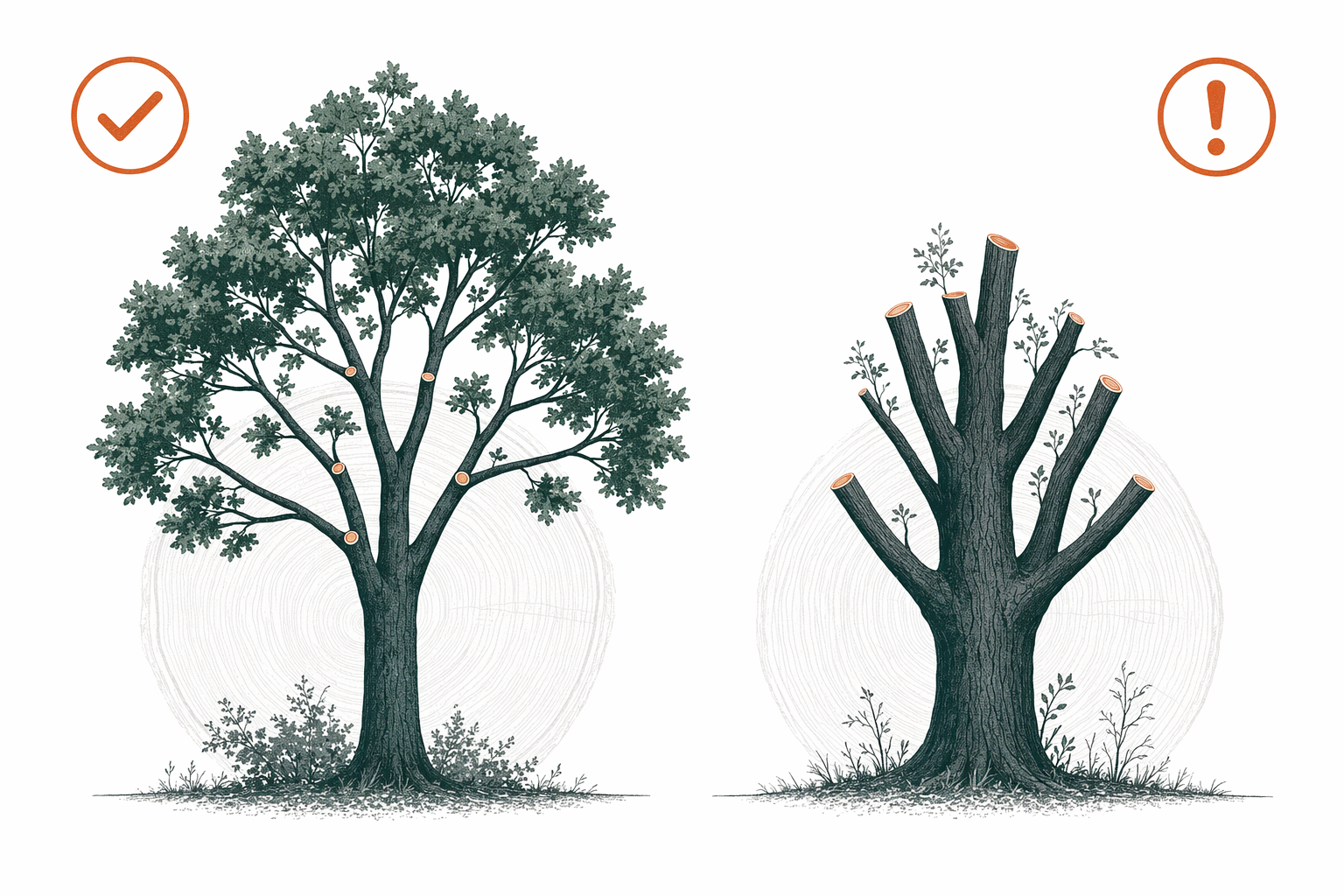
What proper pruning means, and what topping really is
Proper pruning is careful, selective cutting. The goal is to remove dead, broken, diseased, rubbing, or poorly placed branches while keeping the tree's natural shape and strength.
Tree topping is different. Topping means cutting back large branches or the main trunk to stubs, often to make the tree shorter fast. Some crews call it "heading back," "hat-racking," or "rounding over." The sales pitch is usually simple: make it smaller now. The problem is what comes next.
A properly pruned tree is usually cut at a branch union or other correct pruning point. A topped tree is often left with large wounds and blunt ends that the tree cannot handle well.
For homeowners, the short version is this:
- Proper pruning manages risk and structure.
- Topping is a shortcut that often makes the tree weaker, uglier, and more expensive over time.
If you are not sure whether your tree has a hazard issue or just needs routine care, start by learning the warning signs on hazardous tree issues.
Why topping is usually a bad idea
Topping can look like a quick fix, but it often triggers a chain of new problems.
- Weak regrowth: After topping, many trees push out fast new shoots near the cut points. These shoots can grow quickly, but they are often weakly attached. In wind, ice, or storms, they may break more easily.
- Big wounds: Large topping cuts can leave wounds the tree struggles to seal. That can raise the chance of decay and insect problems.
- Sun damage: Branches and leaves protect the trunk and major limbs. Remove too much at once, and bark can get exposed to direct sun and heat.
- Stress: Trees need leaves to make food. Heavy topping removes a lot of leaf area at once and can put the tree under serious stress.
- Ugly shape: A topped tree often grows back in a dense, unnatural form. It can become more expensive to maintain later.
- False sense of safety: Topping does not automatically make a tree safe. In some cases, it creates future failure points.
There are situations where a tree is simply too large for its location, interfering with a structure, or in decline. In those cases, a licensed and insured tree company may recommend other options, including reduction pruning where appropriate, ongoing structural pruning, or removal if the tree cannot be managed safely. Typical tree removal often runs about $400-$2,000+, with large or complex jobs costing more depending on the size and species of the tree, its location and access, hazards, debris haul-away, and the area. You can compare broader tree cost ranges before you talk with companies.
If someone suggests topping as the default answer for every large tree, that is a red flag.
What good pruning usually looks like
Good pruning is not random cutting. A qualified tree company, and ideally an ISA-certified arborist for the assessment, should be able to explain why each cut is being made.
Common goals of proper pruning include:
1. Removing dead, damaged, or diseased limbs.
2. Clearing branches away from roofs, siding, driveways, or walkways where reasonable.
3. Improving spacing and branch structure.
4. Reducing end weight on selected limbs when appropriate.
5. Raising lower limbs for clearance, but not stripping the tree.
Methods may include crown cleaning, crown thinning in limited and appropriate situations, crown raising, or selective reduction pruning. A good crew should not promise to "take half the tree off" just because you asked for more sunlight.
A few honest homeowner tips:
- Ask how much live canopy they plan to remove. Heavy cutting can stress the tree.
- Ask where the cuts will be made. "At proper branch unions" is very different from "we'll just shorten everything."
- Ask what the tree will look like in one year and five years.
- Get the scope in writing. It should list the work, debris haul-away, stump work if any, and cleanup.
Typical trimming and pruning often ranges around $250-$1,200, but the real price depends on the size and species of the tree, its location and access, hazards, debris haul-away, and the area. If a tree also needs the stump handled after removal, stump grinding often runs about $100-$500 as a separate line item. See more on trimming and pruning.
How to hire the right tree company and avoid getting burned
Tree work is dangerous and high-liability. Do not hire casually, and do not let price be the only filter.
Use this checklist:
- Hire a licensed and insured tree company. Verify the license if your area requires one. Verify both general liability insurance and workers' compensation yourself.
- Prefer an ISA-certified arborist for the assessment. That matters even more if the tree is mature, valuable, or may have structural problems.
- Get 2-3 written estimates. You compare the scope, cleanup, timing, and price. You choose who to hire.
- Ask them to describe the pruning method in plain English. If they keep saying "top it and it'll be fine," be careful.
- Ask about permits. Some cities and towns have rules for protected, heritage, street-adjacent, or certain large trees. Local rules vary. Get permit information before work starts.
- Never pay the full amount up front. A deposit may be normal in some cases, but hold final payment until the agreed work is done.
- Watch for storm-chasing door-knockers. After a storm, some crews knock on doors, demand cash, and push rushed work. Be extra careful.
If the tree is touching, leaning into, or down on a power line, stay back, keep other people away, and call the utility company and 911 first. Do not touch the tree, the line, fences, puddles, or anything nearby. For urgent situations, read storm damage tree safety.
If you want help finding companies to compare, get matched for free. TreelineLocal is a free matching service. Participating tree companies pay a flat fee. Homeowners compare estimates and decide who to hire.
When pruning makes sense, and when removal may be the better call
Not every problem tree should be topped. Not every problem tree should be removed right away either. The right answer depends on condition, location, species, age, and risk.
Pruning may make sense when:
- The tree is generally healthy.
- The issue is deadwood, a few overextended limbs, minor clearance, or branch structure.
- A qualified assessment shows the risk can be reduced with selective cuts.
Removal may be worth discussing when:
- The tree has major decay, root failure, severe lean, major storm damage, or repeated large-branch failure.
- The tree was planted in the wrong place and has outgrown the site.
- It is causing repeated conflicts with structures and cannot be managed reasonably.
- Proper pruning would need to be so severe that the tree's long-term health or stability would be poor anyway.
Typical emergency or storm cleanup can range from about $500-$5,000+, and complex removals can go higher. These are only estimates. The real price depends on the size and species of the tree, its location and access, hazards, debris haul-away, and the area.
A good company should be able to explain the tradeoffs honestly, not just sell the biggest job. If the recommendation is removal, ask whether debris haul-away, log removal, and stump grinding are included in writing.
Do not let a crew "top" your tree as a quick fix. Hire a licensed and insured tree company, verify insurance yourself, prefer an ISA-certified arborist for the assessment, get the pruning plan and price in writing, compare estimates, and never pay the full amount up front.