Arborist assessment and tree health
If a tree looks stressed, damaged, or unsafe, a professional assessment can help you understand the risk before you spend money on the wrong work. TreelineLocal is a **free matching service** that helps you connect with licensed, insured tree companies and prefer an ISA-certified arborist for the evaluation.
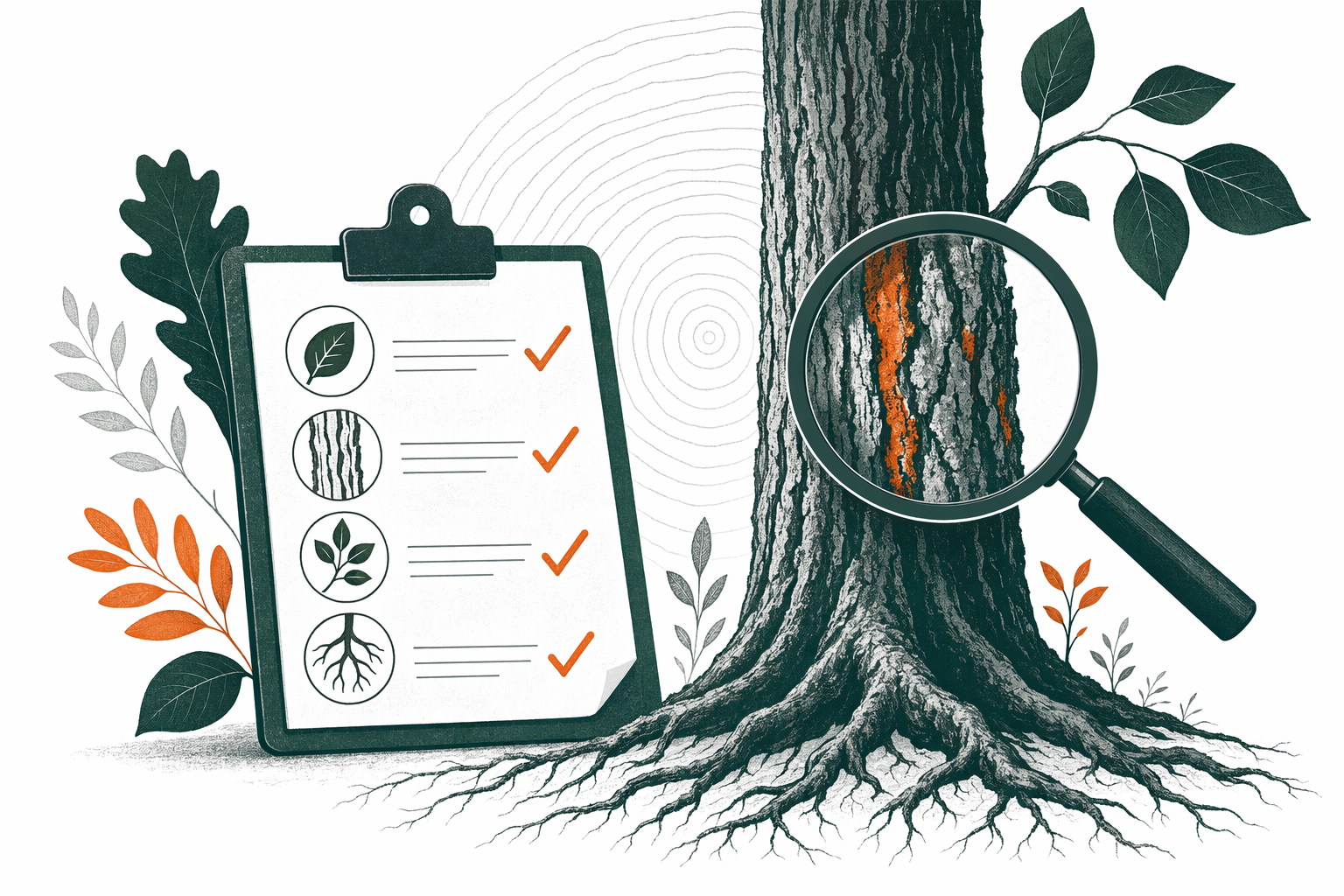
What an arborist assessment is, and why homeowners ask for one
An arborist assessment is a professional look at a tree's health, structure, and risk. The goal is to understand what is happening now, what may get worse, and what options you may have. That can mean pruning, monitoring, soil care, cabling in some cases, or removal if the tree is too risky. A good assessment can also help you avoid unnecessary work.
Homeowners usually ask for an assessment when they notice things like:
- Dead branches in the crown
- Cracks in the trunk or where large limbs attach
- Leaning that looks new or suddenly worse
- Mushrooms or decay near the base
- Roots lifting sidewalks or losing soil around the trunk
- Bare spots, yellowing leaves, or weak growth compared with past years
- Storm damage, lightning damage, or split limbs
- A tree growing near the house, driveway, or power lines
A health problem is not always an emergency. But a tree that is down, broken, or leaning on or near a power line is a life-threatening emergency. Stay back. Keep other people away. Call the utility company and 911 first. Do not touch the tree. Do not try to cut anything near the line.
If you are trying to decide whether to prune, remove, or just monitor a tree, start with an assessment from a licensed and insured tree company and prefer an ISA-certified arborist for the evaluation. If the concern is obvious storm damage, you may also want to read storm tree safety or watch for signs of a hazardous tree.
Typical cost of an arborist assessment
Costs vary by market and by how much time the evaluation takes. Some tree companies offer a basic look as part of an estimate for recommended work. A more detailed arborist visit, written assessment, or multi-tree review may cost more.
Typical ranges:
- Basic on-site assessment tied to a work estimate: sometimes free, sometimes a service fee
- Stand-alone arborist assessment for one tree: often about $75-$300
- More detailed written report or multiple trees: often $300-$800+
- Emergency or after-hours visit: can be higher
These are estimates, not quotes or guarantees. The real price depends on the size and species of the tree, how many trees need review, location and access, visible hazards, whether a written report is needed, and your area.
If the assessment leads to work, common service ranges are often:
- Tree removal: about $400-$2,000+
- Trimming or pruning: about $250-$1,200
- Stump grinding: about $100-$500
- Emergency or storm cleanup: about $500-$5,000+
Those numbers are also typical ranges only. Large trees, crane work, tight access, haul-away, and high-risk conditions can push the price higher. You can compare broader local price ranges on our costs page.
What the assessment process usually looks like
A careful assessment is usually simple for the homeowner. You point out what worries you. The arborist or tree professional inspects the tree and explains what they see in plain language.
A typical visit may include:
- Site walk-around to look at the full tree, nearby structures, driveway, fence, and surrounding trees.
- Trunk and branch inspection for cracks, cavities, decay, weak branch unions, old wounds, and deadwood.
- Root flare and soil check for girdling roots, soil changes, fungal growth, heaving, compaction, or poor drainage.
- Canopy review for dieback, sparse leaves, pests, stress, and unbalanced growth.
- Risk discussion about targets below the tree, such as roofs, cars, play areas, sidewalks, and neighbor property.
- Options and next steps such as pruning, monitoring, improving growing conditions, or discussing whether removal is the safer choice.
Sometimes tools are used for closer inspection, but homeowners should not expect every visit to include a formal lab test or advanced decay testing. If a company recommends work, ask them to explain why in simple terms and show you the actual problem area.
Ask for the scope and price in writing before any work starts. And never pay the full amount up front.
If the likely next step is removing the tree, see tree removal. If the tree may be saved with proper canopy work, compare that with trimming and pruning.
How to hire the right tree company for an assessment
This is where many homeowners get burned. Tree work is dangerous and high-liability. A pickup truck, a ladder, and a chainsaw are not enough.
Use this checklist:
- Hire a licensed and insured tree company where required in your area.
- Verify the license and insurance yourself. Ask for proof of general liability and workers' compensation, and check that it is current.
- Prefer an ISA-certified arborist for the assessment, especially if the tree is valuable, mature, near the house, or possibly hazardous.
- Get the scope in writing. If they suggest pruning, ask what branches, how much, and why.
- Get debris haul-away, stump work, and cleanup in writing if those matter to you.
- Compare estimates. You choose who to hire.
- Hold final payment until the written scope is completed.
Be careful if you hear:
- "We can top it cheap today."
- "Cash only."
- "You need to sign right now."
- "Insurance paperwork is not necessary."
- "We were just in the neighborhood after the storm."
After storms, watch for door-knockers and storm-chasing crews who pressure homeowners and demand cash up front. That is a common way people lose money and still end up with unsafe work.
Also ask about local rules. Some cities and counties have permit requirements for protected, heritage, or street trees. Rules vary. The tree company should know the local process, but you should confirm it yourself with your city or county. That is general information, not legal advice.
If you want help starting the comparison process, use our free matching service. Participating tree companies pay a flat fee to be included. The service is free to homeowners.
What an assessment can and cannot tell you
A good assessment can help you make a smarter decision, but it is not magic.
What it can often tell you:
- Whether the tree shows visible signs of decline or structural weakness
- Whether pruning may reduce risk or improve health
- Whether the tree should be monitored over time
- Whether removal may be the safer or more cost-effective option
- What immediate safety steps make sense while you decide, such as restricting access below a damaged limb
What it cannot promise:
- That a tree will never fail later
- That treatment will definitely save the tree
- Exact pricing until the work scope is set
- That permits are not needed
Tree biology and site conditions are complex. Sometimes the safest answer is not the cheapest short-term answer. Sometimes a tree that looks rough can recover with proper care. Sometimes a tree that still has green leaves is already too compromised to trust near a house.
That is why it helps to get more than one written opinion on expensive or high-risk jobs. You compare estimates. You choose who to hire. You control the final payment.
When to move faster, and when you may have time to compare
Not every tree problem needs same-day action. But some do.
Move fast and call for help right away if:
- A tree or large limb is down or hanging over a road, driveway, or entry door
- The trunk has split deeply or a major scaffold limb has failed
- The root plate is lifting and the tree is actively leaning more
- The tree is touching or near a power line
- A storm left broken limbs hung up high in the canopy
In those cases, keep people away and contact a licensed, insured tree company for emergency response. If power lines are involved, stay back and call the utility company and 911 first. You can learn more about emergency tree service.
You may have time to compare estimates if:
- The concern is slow decline over months or seasons
- You are seeing leaf issues, moderate dieback, or bark damage without active failure
- You want a second opinion before major pruning or removal
- You are dealing with roots, site stress, or general tree health concerns
For non-emergency issues, take a day or two to compare written recommendations. That is often where homeowners save money and avoid unnecessary cutting.
If you are worried about a tree, start with a professional assessment from a licensed, insured tree company and prefer an ISA-certified arborist. Get the recommendation and price in writing, compare estimates, verify insurance yourself, and stay far away from any tree on or near power lines.