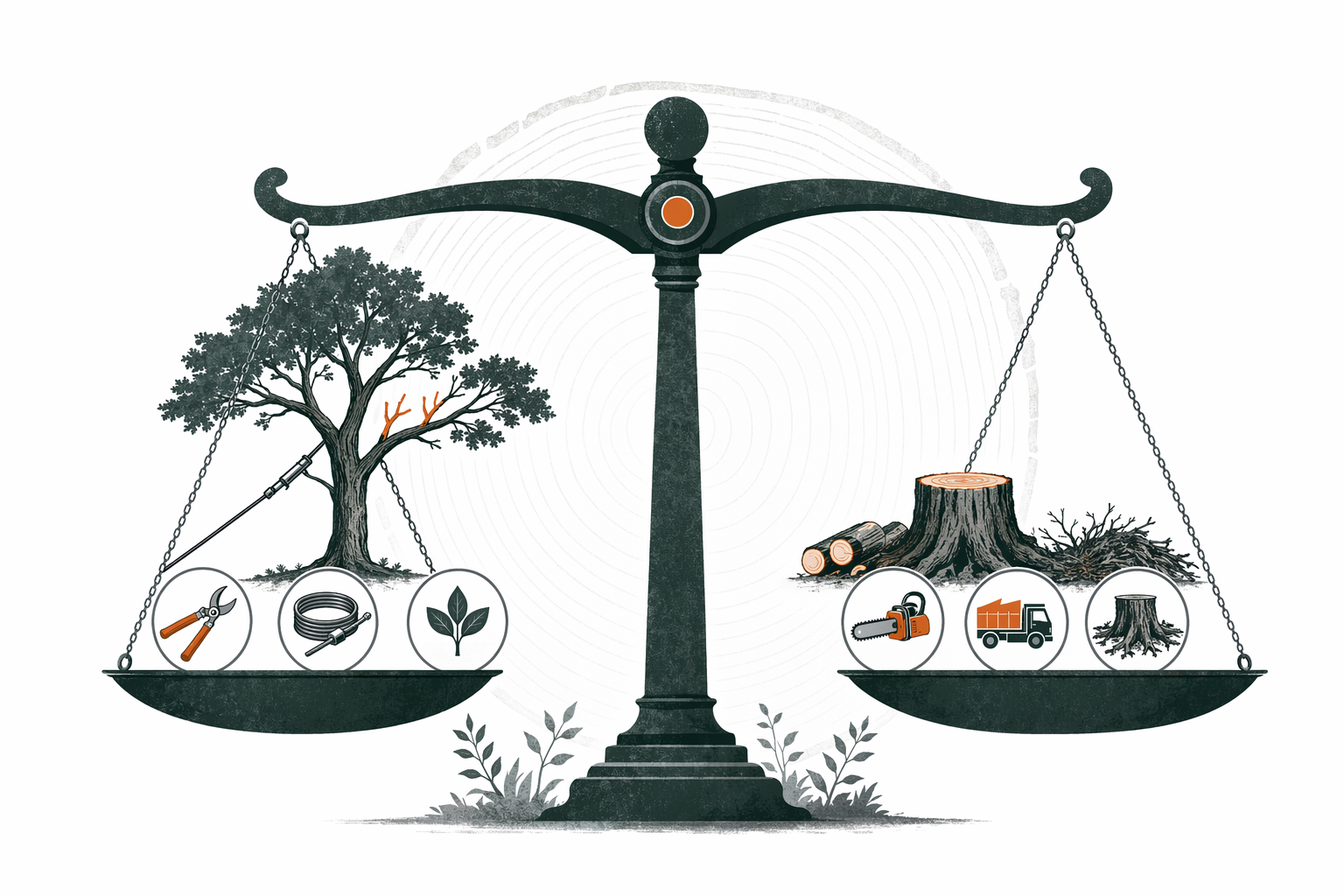
When to remove a tree versus try to save it
Some trees can be pruned, treated, or monitored. Others are too risky to keep. The hard part is knowing the difference before a weak tree damages your home, car, fence, or power lines.
Start with safety, not hope
A tree does not need to be completely dead to be dangerous. A tree can still have green leaves and still be failing at the roots, splitting at the trunk, or leaning more each year.
If a tree is down, cracked, or leaning on or near a power line, treat it as a life-threatening emergency. Stay back. Keep children, pets, and neighbors away. Call the utility company and 911 first. Do not touch the tree, the fence, puddles, or anything the tree is touching.
For non-emergency concerns, the safest first step is an assessment by an ISA-certified arborist. Then hire a licensed and insured tree company if work is needed. Verify the license and insurance yourself, including general liability and workers' compensation. Get the scope of work and price in writing before any work starts, and never pay the full amount up front.
If you are dealing with storm damage, read storm tree safety and be careful of door-knockers who show up right after a storm, push for fast work, or ask for cash up front.
Signs a tree may be saved
Removal is not always the answer. Many trees can stay if the main structure is sound and the problem is limited.
A tree may be a good candidate for saving when:
- The issue is small dead limbs or light storm damage that can be pruned.
- The tree has some disease or pest damage, but most of the canopy is still healthy and the trunk is solid.
- The lean is old and stable, not new, and the root area is not lifting or cracking.
- The branches are overgrown or rubbing, but the tree can likely be improved with proper trimming and pruning.
- The tree has value for shade, privacy, or landscape, and the risk can be reduced to a reasonable level with pruning, cabling, or monitoring.
Possible save options can include selective pruning, weight reduction, removal of deadwood, soil care, or follow-up inspections. Not every company offers every option, which is one reason it helps to compare more than one written estimate.
A tree may be worth trying to save if:
- The trunk is mostly sound.
- The root flare and surrounding soil look stable.
- The defects are limited to one section, not the whole tree.
- The tree is not likely to hit a home, bedroom, driveway, play area, or neighbor's property if a limb fails.
Even then, ask the company to explain why they think the tree can be kept and what future maintenance it will need.
Signs removal is often the safer choice
Some defects are too serious, too costly to manage, or too risky because of where the tree stands. In those cases, removal is often the practical choice.
Common red flags:
- Large dead sections in the canopy, especially in a big tree near a house
- Deep cracks in the trunk or major limbs
- Splitting trunks or a tree with multiple stems pulling apart
- Hollow trunk or advanced internal decay at the base
- Root problems, including heaving soil, exposed broken roots, mushrooms near the base, or a sudden lean
- A tree that has dropped big limbs before
- Severe storm damage where more than a small portion of the crown is lost
- A tree that is dead and tall enough to hit something valuable
- A tree planted too close to the house, garage, septic area, driveway, or retaining wall, where future growth raises risk and cost
Location matters as much as condition. A marginal tree in the back corner of a large lot may be watched. The same tree next to a child's bedroom, parked cars, or a busy sidewalk may need to come down.
If you want help understanding common danger signs before you talk to companies, see signs of a hazardous tree.
Also remember that some cities and towns have permit rules for protected, heritage, or street trees. Even a dead or damaged tree may need approval before removal. Rules vary by city and county, so check local requirements. This is general information, not legal advice.
How to decide without getting pressured
Homeowners often get pushed into the wrong job. Sometimes a company says a tree must come down when pruning may be enough. Other times a risky tree gets downplayed because removal is harder work. A simple process helps.
1. Take clear photos of the whole tree, base, trunk, lean, and damaged limbs.
2. Describe what changed. New lean? Recent storm? Cracks? Falling branches? Mushrooms at the base?
3. Get 2-3 written estimates from licensed and insured tree companies. Ask whether an ISA-certified arborist looked at it.
4. Ask each company the same questions:
- What defect do you see?
- Can this tree be reasonably saved?
- If yes, what work would reduce the risk, and for how long?
- If no, why is removal safer?
- Is stump grinding separate?
- Is debris haul-away included?
- Will I need a permit?
5. Compare the scope, not just the price. One bid may include haul-away, traffic control, cleanup, and stump grinding. Another may not.
6. Do not pay in full up front. A normal schedule is a deposit or progress payments, with final payment after the agreed work is finished.
Typical price ranges can help you spot an unrealistic bid, but they are estimates, not quotes. Real cost depends on the tree's size and species, its location and access, hazards, debris haul-away, and your area.
- Tree removal often runs about $400-$2,000+. Large or complex removals can be higher.
- Trimming or pruning often runs about $250-$1,200.
- Stump grinding often runs about $100-$500.
- Emergency or storm cleanup often runs about $500-$5,000+.
If a price is far below the others, ask what is missing. Low bids sometimes skip insurance, cleanup, permits, or safe rigging methods.
When removal makes financial sense
Sometimes the question is not only, "Can the tree be saved?" It is also, "Is it smart to keep putting money into this tree?"
Removal may make more sense when:
- The tree needs repeated heavy pruning every few years to stay barely safe
- Disease or decay is likely to keep getting worse
- Root damage is advanced and cannot be fixed
- The tree's species has a weak structure or poor long-term fit for that spot
- The cost to maintain it over time is close to or more than removal
That does not mean every imperfect tree should be cut down. Mature trees add shade, curb appeal, and value. But if the tree has a serious defect in a high-target area, keeping it can become the more expensive choice after roof damage, car damage, or an injury claim.
TreelineLocal is a free matching service. We help homeowners compare licensed, insured tree companies so you can review estimates, you choose who to hire, and you hold the final payment. If you're ready to compare local options, start here: get matched.
If a tree has a new lean, deep cracks, root problems, large dead sections, or is close to your house or power lines, do not guess. Get 2-3 written estimates from licensed and insured tree companies, prefer an ISA-certified arborist for the assessment, verify coverage yourself, and compare whether pruning can reasonably reduce the risk or removal is the safer choice.