A tree fell on my house — what do I do?
First, protect people. A tree on a house can involve hidden structural damage, live power lines, broken gas lines, and unstable limbs. Move carefully, call the right people, and do not let anyone rush you into a bad decision.
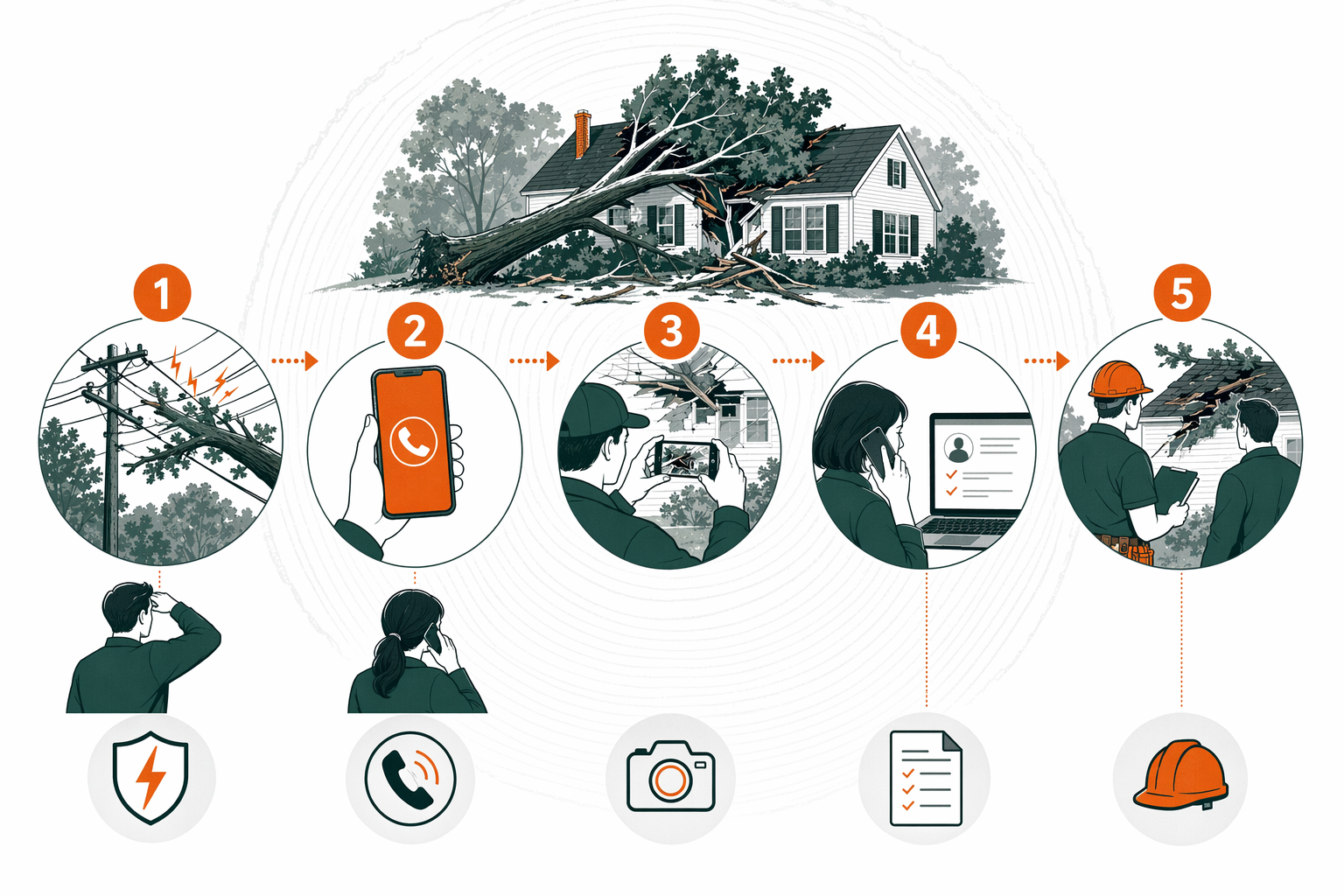
Start with safety: get people out, then call for help
If a tree has fallen on your home, treat it like an active hazard. Roofs can collapse later. Branches can shift. Wires may still be live even if they look quiet.
- Check for injuries. If anyone may be hurt, call 911 now.
- Get everyone out if it is safe to leave. Use a door away from the damaged area if you can. Do not walk under sagging ceilings or hanging limbs.
- Stay back from the house if the tree is touching electrical service, pulling down wires, or leaning across the structure.
- If the tree is on or near a power line, keep everyone away and call the utility company and 911 first. A downed or leaning tree near power lines is a life-threatening emergency. Do not touch the tree, the house, a fence, a car, or wet ground nearby if wires may be involved.
- If you smell gas, hear hissing, or suspect a gas line problem, leave immediately and call 911 and your gas utility from a safe distance.
Do not climb on the roof. Do not go into the attic to "take a quick look." Do not start cutting branches yourself. Tree work is dangerous even in normal conditions. After a storm or collapse, it is much riskier.
If the tree came down during severe weather, you can read more about immediate hazards here: storm damage tree safety.
Who to call first, and what each call is for
After everyone is in a safe place, make these calls in this order if needed:
- 911 for injuries, fire, sparks, smoking wires, a gas leak, or immediate danger.
- Utility company if any wire is down, pulled, sparking, or touching the tree or house.
- Your homeowners insurance company to open a claim. Ask what emergency steps they want documented and whether they have limits for temporary repairs.
- A licensed, insured tree company for emergency stabilization and removal of the tree from the structure.
- A roofer or general contractor later, if the home needs structural or roof repair after the tree is safely removed.
A few important notes:
- TreelineLocal is a free matching service. We help you connect with licensed and insured tree companies. We do not do tree work ourselves.
- Ask the tree company to provide proof of liability insurance and workers' compensation. Verify both yourself. Do not rely only on a logo on a truck or a certificate photo on a phone.
- For the assessment, it is smart to prefer an ISA-certified arborist when possible, especially if the tree is partly standing, tangled with other trees, or the cause of the failure is unclear.
- Get the scope and price in writing before work starts. Never pay the full amount up front.
If you need help finding companies to compare, start here: get matched. If you want a checklist for screening them, use how to vet a tree company.
What to document before cleanup starts
Take photos and notes before major debris is moved, if you can do it safely from the ground. Good documentation can help with insurance and reduce arguments later.
Take clear photos of:
- The whole house from several angles
- The trunk, broken limbs, root plate, and where the tree landed
- Roof damage, gutters, siding, windows, chimney, fence, and vehicles
- Any nearby wires, meter area, or service mast from a safe distance
- Interior water leaks, ceiling cracks, wet insulation, or collapsed drywall
Write down:
- The date and time
- The storm or event that happened
- When you noticed the damage
- Any emergency steps you took, like tarping by a roofer or shutting off utilities
- Names of people you spoke with at insurance, the utility, and the tree company
Keep receipts for emergency expenses like tarps, hotel stays if your insurer approves them, and temporary repairs.
Do not let cleanup destroy evidence you may need for your claim. At the same time, most policies expect homeowners to take reasonable steps to prevent more damage, such as stopping active water intrusion once it is safe. Your insurer can tell you what they want saved.
If the tree did not fully fall but was already cracked, leaning, or dead beforehand, that may matter later. Here are common warning signs homeowners often miss: signs of a hazardous tree.
How emergency tree removal usually works
When a tree company arrives, the goal is usually to make the site safer first, then remove weight from the structure in a controlled way. This is not the same as a normal backyard removal.
A typical emergency job may include:
- Site safety check for overhead hazards, access limits, and whether utilities must secure the area first.
- Stabilizing the work area so limbs and trunk sections do not roll or punch deeper into the roof.
- Section-by-section removal using ropes, rigging, cranes, or bucket access if space allows.
- Debris haul-away or stacking cut material where your insurer wants it kept temporarily.
- Tarping or temporary weather protection by the appropriate trade if the roof is opened up.
Ask these questions before you hire:
- Are you licensed and insured for this kind of work in my area?
- Can you show proof of liability and workers' comp that I can verify?
- Who is responsible for protecting the driveway, lawn, and fence from equipment damage?
- Does your written scope include haul-away, log removal, and cleanup?
- Are you removing only the portion on the house, or the entire tree?
- If there is a stump left, is grinding included or separate?
- Will permits be needed if this is a protected or heritage tree in my city or county?
Local rules vary. Some places require permits for protected trees even after storm damage, while others allow emergency work first with follow-up documentation. The tree company or your city can explain the local process, but for legal questions, check with the local authority directly.
For related service details and typical pricing, see emergency tree service and tree removal.
What it may cost, and where homeowners get burned
Emergency tree work on a house is often expensive because the job is dangerous, time-sensitive, and may need specialty equipment.
Typical ranges only, not quotes or guarantees:
- Emergency/storm cleanup: $500-$5,000+
- Tree removal: $400-$2,000+ for many standard jobs, with large or complex removals higher
- Trimming/pruning: $250-$1,200
- Stump grinding: $100-$500
The real price depends on:
- Size and species of the tree
- Location and access to the house and yard
- Hazards, including roof load, nearby structures, and utilities
- Whether a crane or special rigging is needed
- Debris haul-away and cleanup level
- Your local area and storm demand
After a widespread storm, watch for storm-chasing door-knockers. Common red flags:
- They show up uninvited and say they are "working in the neighborhood"
- They push for cash up front
- They cannot show real insurance you can verify
- They want you to sign a vague contract on the spot
- They say "insurance will cover it" but will not give a clear written scope
Protect yourself:
- Compare 2-3 written estimates when the situation is stable enough to do so
- Make sure each estimate lists the same scope
- Never pay the full amount up front
- Hold final payment until the agreed work is done
- You compare estimates, you choose who to hire, and you hold the final payment
If you want a broader pricing guide, see tree service costs.
What to do in the next 24 to 72 hours
Once the immediate danger is handled, focus on preventing more damage and keeping your paperwork organized.
- Follow your insurer's instructions about inspections, photos, and temporary repairs.
- If the home is exposed, arrange temporary protection such as tarping through the proper company.
- Keep children and pets away from the damage area.
- Ask the tree company for a written invoice and scope that separates emergency work from optional extra work.
- If more trees on the property look cracked, hollow, uprooted, or newly leaning, ask for an assessment by an ISA-certified arborist.
- If a stump remains, decide later whether to remove it. It is often a separate service: stump grinding.
If the house is not safe to stay in, ask your insurance company what temporary living expenses may be covered under your policy.
The main thing is simple: take the danger seriously, slow down enough to verify who you hire, and get everything in writing.
If a tree fell on your house, get people to safety first, stay away from wires, call 911 and the utility if lines are involved, then call your insurer and a licensed, insured tree company. Take photos from a safe place, get the scope and price in writing, verify insurance yourself, and never pay the full amount up front.